

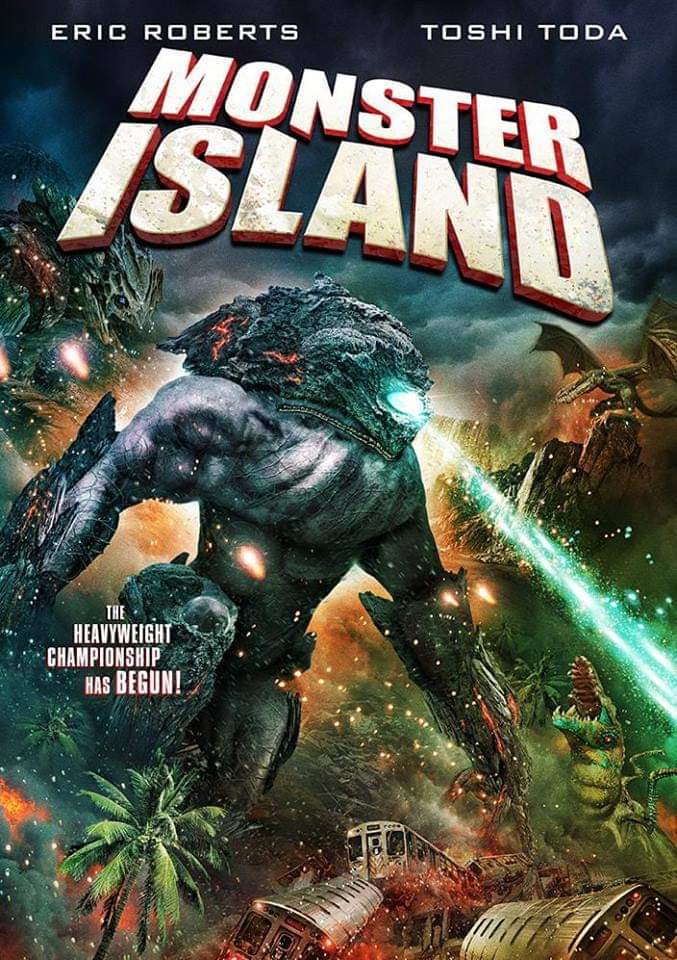
Monster Island (2019)
Director: Mark Atkins
Writer: Mark Atkins
Starring: Eric Roberts, Toshi Toda, Adrian Bouchet, Natalie Robbie, Donna Cormack Thomson
Gigantic monsters threaten to destroy everything in their path as mankind remains defenceless.
In a new interview following Horror-on-Sea Film Festival, I got a chance to ask Monster Island writer-director Mark Atkins a few questions about what we can expect from the film.
Q. Your latest horror film Monster Island has been selected to play at Horror-on-Sea. Can you tell us what we can expect from the film?
Viewers of Monster Island can expect an ocean-based giant monster movie with a knock-out cast and set in the world of deep-sea mining on volcanic seamounts. Combining aquatic based action and horror with compelling characters who encounter Kaiju with completely new biology threatening mankind. We are honoured to be returning to Horror-on-Sea with Monster Island and hope fans of giant monsters will come out and watch the show.
We are also fortunate to be working with some of the cast from our previous movies which played at Horror-on-Sea like Chris Fisher and Meghan Oberholzer. Chris who starred in 6-Headed Shark Attack (2018) has a chance to extend with his comic chops and we hope audiences enjoy the dynamic between cast members Donna Cormack-Thomson, Adrian Bouchet, Natalie Robbie and Margot Wood. Southend-on-Sea audiences as well should recognize Adrian Bouchet from In the Name of Ben-Hur (2016) where he played the title character. We are happy to come back; my only regret is that I unable to attend the festival this year especially when so many great horror movies that I have been reading all year are playing at the festival.
Q. What were your influences when writing the screenplay for the film?
The screenplay was influenced by the premise of geomythology which examines indigenous knowledge, storytelling, histories and myths for evidence of natural disasters in the distant past. Often the stories are literal with tales of tsunami survivors lashing themselves to trees to make it through a tsunami waves in the Pacific Northwest, but others have more fantastic elements with mythological monsters battling in the South Pacific, which scientists connect to phenomena like volcanic eruptions in the historical record. My concept was — what if not only did the stories represent natural phenomena and disasters but what if they actually represented true accounts of monsters from the distant past? And — what if a deep-sea mining expedition investigates an unexplored seamount encounters a monster which can only be defeated by applying the ancient knowledge of our ancestors? Find out the answer in Monster Island.
Q. What were some of your influences for the look and style of the film?
Because we were telling a story containing enormous Kaiju, we decided to go with full frame lenses, specifically Sigma Cine Primes. We needed to be able to go wide to fit in the massive size of the monsters we were envisioning in the frame and we also wanted to showcase the mind-blowingly epic South African locations like Stadsaal caves in Cederberg which feature gargantuan open-ended wind-eroded sandstone caverns that look out into expansive vistas dotted with miles and miles of monolithic boulders.

For our colour palette wanted to emphasize the warm glow of lava with the deep blue of the ocean. These contrasting colours highlighted the underwater action in the film, and we used deepening colour to illustrate the escalating conflict as our characters find themselves a battle to save the planet.
We also tried in our small way to include elements that would place Monster Island into the continuum of Kaiju movies. Thanks to Special Advisor and Publicist Avery Guerra we signed up Kaiju fan favourite Toshi Toda from 1998’s Godzilla as well as threw in a few easter eggs that hint giant Monster fans should enjoy.
Q. What was your favourite monster to bring to life?
Being a lover of monsters and monster movies, it was a joy bringing the various Kaiju to life in Monster Island. I wanted the monsters have unique biology and formidable defences such as having molten magma for blood. We were very fortunate to have great collaborators to work with on designing the monsters. For the giant multi-armed Tengu Kaiju, the legendary comic book artist Matt Frank came on board. Matt Frank has brought some of the most memorable and world-famous Kaiju to life in multiple comic books and thanks to an introduction by my friend Avery Guerra, Matt brought his considerable talents to the design of the Tengu Kaiju.
When it came to realizing the designs in CGI, Sasha Burrow, took on the Living Mountain and Flying Kaiju as well as realizing the massive Tengu from Matt’s designs.
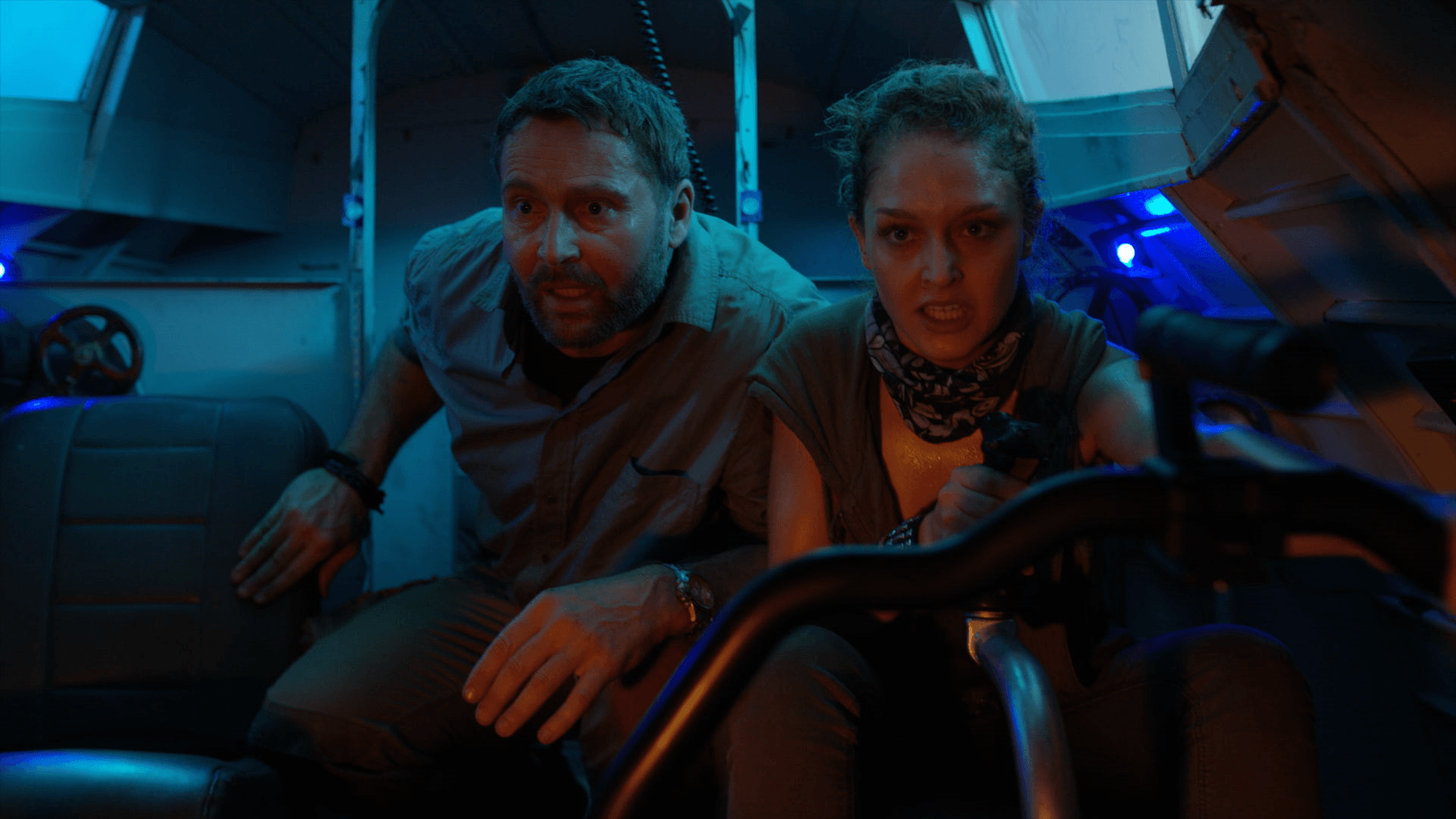
I can’t say I have a favourite Kaiju, but I do have favourite moments with each Kaiju. I love the moment that our heroes played by Adrian Bouchet, Natalie Robbie, Chris Fisher and Donna Cormack-Thompson discover their minisub has run aground on a living entity, the Tengu Kaiju. Everyone’s reactions to with what they see out the window of the minisub combined with the sound design Craig Polding, Lisa Ries and team adds up to an entertaining and memorable moment for me.

I also enjoy the scene where our same group of heroes encounter a Kaiju hatching from an egg and a soldier played by Lindsay Sullivan must confront a creature that spews lava from its jaws and flies like a dragon.
The third monster moment that I love with the Kaiju is the when our characters played by Margot Wood, Natalie Robbie and Donna Cormack Thompson witness the Living Mountain, a gigantic elemental Kaiju, erupting from the earth in the dramatic Cederberg landscape. Their reactions were spot on and we had the luck of desert wind whipping through their hair adding to the reality of the moment. The actors’ work combined with fantastic music and sound design and the visual effects team led by Glenn Campbell efforts to create the Living Mountain Kaiju busting out of the earth resulted in one of my favourite moments in the film and I hope that audiences enjoy it as well.
Q. Where there any elements of the original script which were adapted during filming?
Fortunately we didn’t have to adapt elements of the script during filming. Our Line Producer Erica Steele and her team Sandi Shultz and Coordinator Giedre Apanaviciute — were able to secure the epic locations required and to do the fiscal magic and scheduling along with our first A.D. Laszlo Bene that enabled us to shoot the script we had, and power through obstacles like limited time and budget.
The whole crew knocked it out of the park including Production Designer Ray Wahl who build amazing sets like our minisub which allowed 360 degree shooting and interactive lighting by our camera and lighting team lead by Juan Le Roux and Casper Erasmus.
So, our production didn’t require adapting the original script, however once we got in the postproduction, it was a different matter. In particular, the we ran into the realities of delivering visual effects on the scale for creating the giant Kaiju on such a short schedule. This required us to adapt certain scenes with the Kaiju for the ending of the movie and simplify the action from the original script.

The original script had more of an extended battle with the Kaiju in the end of the movie than what we were able to accomplish in the time allotted. I may have bitten off more than we could chew but my hat’s off to visual effects team for what the accomplished working on an insanely restricted time frame. We had a fantastic team working on bringing the monsters to life, including Sasha Burrow and a global team headed up by my friend VFX Supervisor Glenn Campbell, whose resume ranges from Tron (1982) to Sharknado (2013). Because of our release date and budget, we had about two weeks to complete all the visual effects. If you think this sounds impossible, I would say it nearly was but for the efforts of the artists involved. During that period there were numerous nights where Glenn and his team would work from dawn to dusk to complete shots for the movie. The artists went above and beyond to bring the movie to life.
Many sequences we were able to fully realize what was in the script, but the end Kaiju battle had to be simplified to a minimum of shots and that conveyed the story. For me now as a result of this change, a few moments play out as more magical or fantastical than originally intended when the Living Mountain Kaiju has to come up against its opponents, but I hope audiences are pulled in by the story and can accept more mystery in the action. It wasn’t possible to do more on our budget. I am indebted to Glenn and everyone on the team for bringing the monsters to life, they put in maximum effort and I think if audiences believe that there are living breathing Kaiju onscreen in Monster Island, it is their work that bears the lion’s share of credit.
Q. Did you experience any issues whilst filming?
We did have some fairly unique experiences for a film, and they involved a charismatic resident of where we were filming. We shot and did most of the edit for Monster Island in Cape Town South Africa. Most of our work was near Cape Point Nature Reserve which is well known for bold troops of baboons. I remember one day we were out filming, and we got a call from our drone pilot and editor Marq Morrison who stayed behind to film aerial shots. Apparently, the neighbourhood was under siege from a troop of baboons which had discovered that the nutritional value of foraging inside houses was way higher than foraging outside. I remember Marq relating how he and Geidre scrambled to lock all the doors and windows as the baboons made door to door raids and how he watched an infant baboon excitedly running off with some shiny object pilfered from a neighbouring home. Little did I know that this would not be our closest encounter.

A couple of weeks later while Marq, Erica Steele and I were working on the edit in our rented house in Scarborough and had quite a memorable experience. One morning, Marq and I were making our way back into the house after grabbing a coffee nearby when we heard a commotion coming from the kitchen. Erica let out a war cry overtop the unruly screams of a pair of baboons, a mother and unruly youngster, who had entered the kitchen through the open back door. Erica had been working on the edit in the dining room when she saw furry shapes in the kitchen which on first glance appeared to be dogs until slender arms and hands reached up to grab a bag of apples and granola from the counter. At this point Erica leapt into action to run off the baboons with her best rebel yell and this is precisely when Marq and I entered catching a glimpse of the baboons running out the back door.
The biggest lesson I learned aside from keeping your door locked, is there is no point in splurging on expensive granola as no matter how hard you try, it will end up on the roof on your garage in the hands of adversaries who sit and eat it staring back down at you in defiance. And that is how our baboon experience ended with Marq, Erica and I watching the baboons having a breakfast of apples and granola out of reach on the roof of our garage. We were fortunate it was only two baboons that came in rather than a whole troop.
The possibility of encountering wildlife is one of the many reasons, we love filming in South Africa, ignoring the baboon banditry, the surrounding ocean is filled with dolphins, whales, seals and penguins and it is not uncommon to see all of these amazing creatures in a single day. On previous shoots we had amazing encounters offshore when a superpods of dolphins shared our set. South Africa is truly an amazing place to make movies.
Q. What was one of your favourite moments during the filming of Monster Island?
My favourite moments on Monster Island occurred working on set with our actors. Highlights include filming on the minisub set with Adrian Bouchet, Natalie Robbie, Chris Fisher and Donna Cormack Thomson. Ray Wahl had designed our minisub with a significant range of motion so that we could simulate the crashing and running into the giant Tengu Kaiju. The whole minisub, which was adapted from a plane cockpit, was placed on giant truck tires so we could knock it around and the actors were able to respond to the action when encountering the Kaiju. It was broiling hot on set and the actors and we had special lighting rigs to simulate from being on the surface to descending deep beneath the sea. Once we got into the action and combined the camera in with interactive lights and moving set, it was a joy watching the actors in the moment as the minisub was had its first raucous encounter with a Kaiju.

I also enjoyed working with actress Margot Wood who brought such gravitas and panache to her role as monster expert, Rena Hangaroa. For me Margot added jet fuel to scenes and loved every minute of watching her performance. She and all our cast had a great creative synergy.
Finally I was thankful to get to work with our team, both cast and crew, many of which like Line Producer and Casting director Erica Steele have been collaborators for a long time and others who have become like family as we have journeyed together to make many films over the last few years. In addition, having a chance to work with the fantastic Jonathan Pienaar again and put him in the mix with another frequent collaborator Adrian Bouchet was quite exciting. You never knew what might happen in a scene with these collaborators.
It was a fantastic experience overall and I hope to be able to continue working with our film family.
Q. What makes Monster Island stand out as something different in the horror genre?
I hope that a compelling story with a knockout cast diving deep into the mysterious undersea world of giant monsters and monster lore can draw fans into the movie.
Q. What do you hope people take away after watching the film?
I hope that people take away the concept that the answers to problems in the future might be found by looking into the solutions of people of the past. The knowledge of the past is important to the future.
Q. Do you have any other projects which you are currently working on?
I have various projects in multiple genres in different stages of development. Monsters and science fiction are close to my heart so if I am so fortunate one day in the future, I may have another project to share with the audiences at Horror-on-Sea film festival.
Q. If someone was looking to write and direct their own film what advice would you give them?
Follow your voice. I believe having a unique voice and also choosing an original story and subject are important for a first-time writer/director. We live in a time where the bar for entry into film making has been lowered and more and more people can become storytellers as the tools become democratized. If you have a unique perspective and an original story that allows your voice to speak through it, this will help your film stand out from the crowd. Audiences are hungry for new perspectives and visions and I think as a writer/director, you have an opportunity to create something that strikes a chord with a large audience by following your voice.
And finally, I’ve said this before — but I strongly believe in it, if you do make your own film, protect your crew and cast, treat them well as they are your collaborators in the journey bringing the story to life. Value and cherish the people you work with and their efforts, it will pay off in friends and collaborators that if you are lucky, you will have for life.

Published in various websites, Philip is a reviewer who is best known for his interviews and media coverage of independent projects including; films, books, theatre and live events. Always on the lookout for something different to cover!