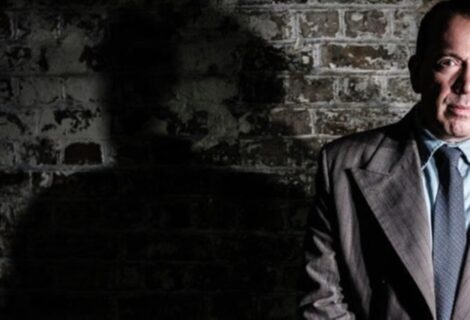
Film Name: Ol’ Silus
Director: Phillip Trow
Writer: Phillip Trow
Starring: Belinda Owusu and Ethan Lawrence
Two strangers form a suicide pact when Wodenleigh’s ancient curse is awakened and begins passing on a grisly demise through the lens of a camera, but will Irene and Howard’s sacrifice be enough to satiate the bloody revenge of Ol’ Silus?
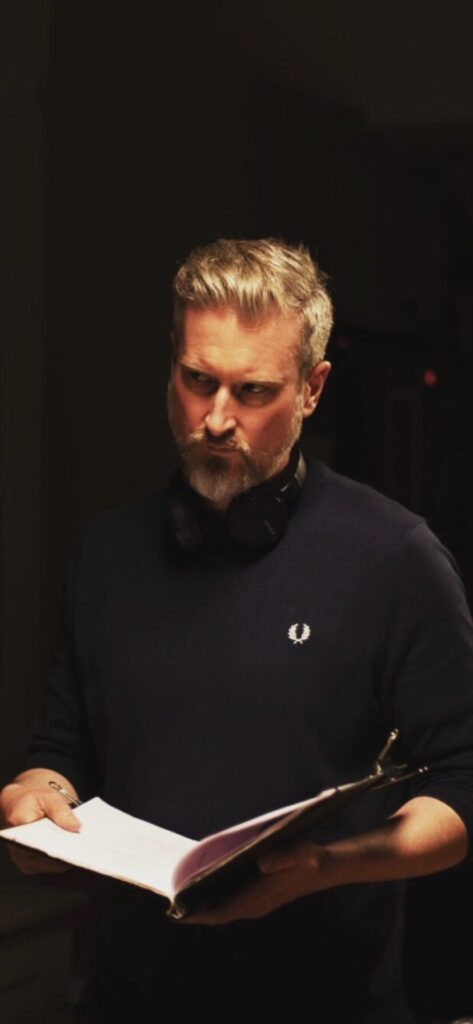
In a new exclusive interview on Blazing Minds I got a chance to ask Director / Co-Writer Vadir Sottelo a few questions about his film ‘Ol’ Silus‘ which will have its World Premiere at Horror-on-Sea on Sunday 18th January at 10:00hrs.
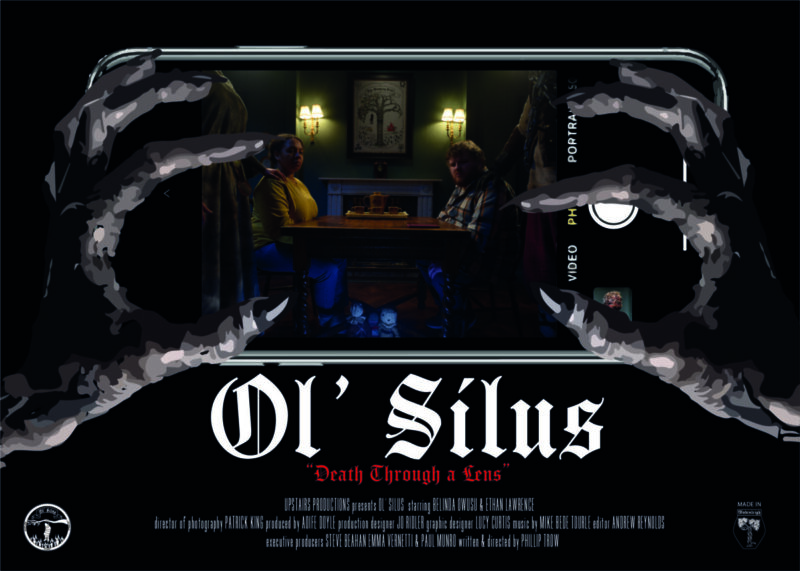
Q. Your film Ol’ Silus has been selected to play at the Horror-on-Sea Film Festival. Can you tell us what we can expect?
You can expect to lose yourself in a dark and disturbing tale of folk horror, combining a centuries old curse with modern technology. Ol’ Silus initially appearing in the background of photos and videos taken by the villagers of Wodenleigh, but edging closer and closer with every click of the camera, until he turns, drops his hood and reveals his hideously deformed face. The last thing they’ll ever see.
Two strangers, Howard Ward, born and bred in the village, but left the second he was old enough, and Irene Wood, who married into Wodenleigh, but as a woman of colour, had to deal with prejudice and bigotry. They are the only two survivors who join together in a suicide pact, attempting to prevent the curse from escaping the village. As the tale unfolds, we not only learn about the dark history of Wodenleigh, the struggles both Irene and Howard have had to overcome, and of course the curse of, Ol’ Silus. We also begin to understand how, over centuries, an ancient evil has seeped into the very fabric of the village, begging the question, in Ol’ Silus’ eyes, are we all children of Wodenleigh?
Q. What were your inspirations when writing the script?
I adapted Ol’ Silus from a feature script I wrote years ago called, Selfie. Typically, I realised the ideas and characters that came out of the process of developing the shorter version were far stronger, so at some point I’ll have to return to the feature. However, the origins of the story come from an old university mate, whose Mum has part of the family that owned and lived in Alton House (as in Alton Towers). He told me a story about a tree on the grounds which had its branches chained up centuries ago after a witch cursed an aristocrat when he refused to give her money, claiming that if a branch was to break off and hit the ground, a member of his family would die. Initially dismissing the woman, the aristocrat chained up the tree anyway, you know, just in case. That story has always stuck in my head & many years later, I based the whole dark history of a fictional village called, Wodenleigh around a chained tree.
Q. Did you have any of the cast in mind for the characters when writing the script?
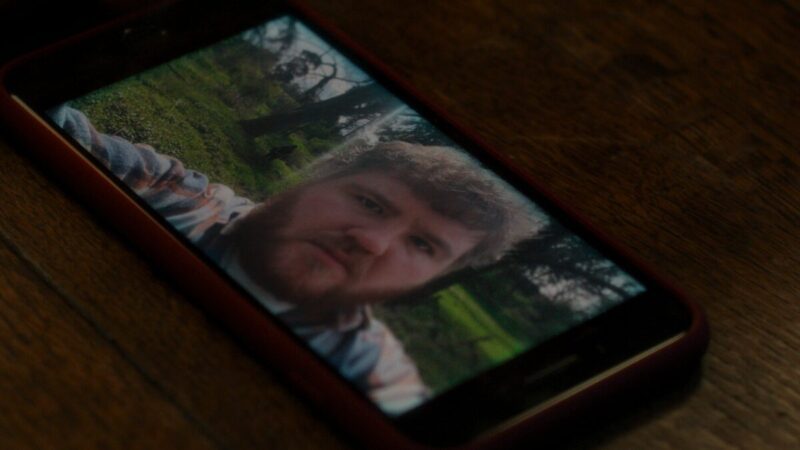
Ethan was always in my mind when writing Howard, but there was another actor who’d originally agreed to play Irene, who had to pull out due to work commitments. However, I remembered working with Belinda many years ago on EastEnders, where she played, Libby Fox and thinking what a superb actor she was, so I sent her agent an email and happily she loved the script & agreed to be part of the film.
Q. What were some of your influences for the look and style of the film?
I’m a huge fan of folk horror and I guess when thinking of Howard and Irene sat at the table, Ari Astor’s Hereditary was always at the back of my mind, but the remote, isolated sense of Wodenleigh as a location pays tributes to classics like The Wickerman (1973) and more modern films like, Starve Acre (2023). A huge influence for me is a TV movie that I saw far too young, when my Nan was babysitting and fell asleep, called Crowhaven Farm. From memory, the film focused on a woman who ends up on a remote farm, suffering flashbacks to a former life where she was wrongly accused of witchcraft and sentenced to death. To this day I still have vivid images of the woman being crushed by the pile of rocks that the villagers slowly pile on top of her. After all this time, I can still remember a seven year old, Phil struggling to understand the injustice and cruelty of the murder and just wanting something or someone to stop her suffering, but no one did. A bit like poor Howard Ward.
Q. Did you make any changes from the original script during filming?
To be honest, no, not really, with maybe the exception of the actors paraphrasing here and there to make things sound more natural, we pretty much stuck entirely to the script. I think the issue is that the film is so dialogue heavy, if you started chopping & changing lines it would have been incredibly unfair on the cast. Of course, it was also superbly written … but joking aside, the changes only really came in post-production when pacing became the focus and bits & pieces were cut to help the film move along and hopefully get the running time to under fifteen minutes, which is always the aim, but something I can never seem to do.
Q. What were some of your favourite moments during filming?
I always find it staggering when actors start speaking the words I’ve written and they somehow make it believable, but I have to say that watching the performances of both Belinda and Ethan was an absolute joy. The on-screen heavy lifting is solely on their shoulders and they both had a lot of dialogue to deliver.
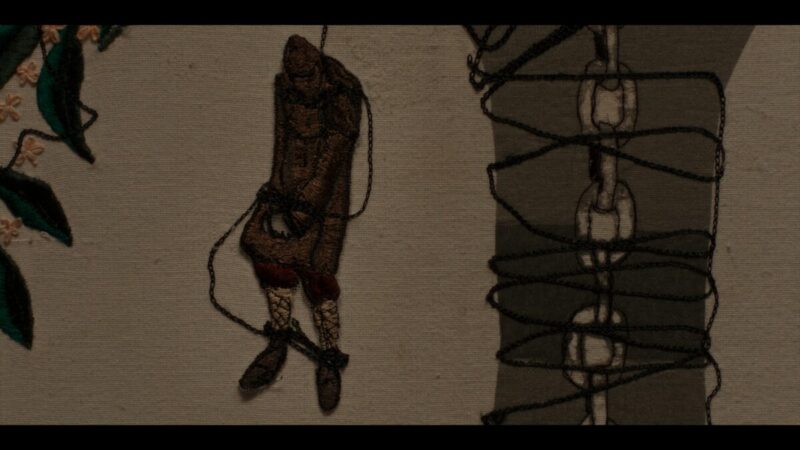
Not only did they come to set knowing every line and understanding exactly what they were going to do, but they completely nailed it and throughout the drawn out editing process, it never became a chore watching their work. Other highlights would be the Ol’ Silus’ chains and the blood aspects, courtesy of our brilliant Production Designer, Jo Ridler. Of course, it would be remiss of me not to mention how the embroidery, created by my old school friend, Rebecca Warrington, came to life on screen, almost becoming a character in itself.
Q. Did you experience any issues during filming?
I chipped a filling on day one, that was quite frustrating, not to mention painful. Other than that, I don’t think we did really. We found the perfect location, planned it to within an inch of its life and had two actors that were professional, prepared and brilliant. Both my DOP, Patrick King and myself work in the industry, so we were able to assemble a crew of friends who were all reliable and brought their A -games and Producer Aoife, 1st AD, Charlie and Associate Producer, Sarah looked after all the logistics, so as a team, we totally nailed it. We also learned a lot from making, Upstairs back in February 2020 where we only scheduled a two day shoot, which was tough and incredibly frustrating, so we filmed Ol’ Silus over four days. One day of embroidery & detail cut-aways and three days with the actors which allowed us to do everything right. Nothing was rushed, we had a clear vision and we stuck to the plan.
Q. What makes Ol’ Silus stand out as something different in the horror genre?
I think Ol’ Silus and Matilda’s back story are both dark & detailed, but of course the horror genre is packed full of fantastic and disturbing characters manifested from all manner of evil origins. What I really wanted to achieve with Ol’ Silus was to give the sense that Matilda’s curse isn’t just affecting Irene and Howard, or even the villagers, but literally everything in Wodenleigh. The very fibre of the place is haunted, the fire, the dolls, the camera lenses, the material of the embroidery, everything is tainted by the dark history of the village. I guess the question is, with all the inhabitants of the village dead, what does the evil do? Would it disperse or would it lie in wait, dormant, until new victims stumble into its path.
Q. What do you hope people take away after watching the film?
I hope the audience takes away a complete sense of the injustice and prejudice that started centuries ago with Matilda and Silus and centuries later, is mimicked by the situation Irene and Howard find themselves in. In no way do I regard the film as political, but I would love people to recognise that Irene and Howard are both outsiders. Howard bullied and ousted for his sexuality, and Irene for not being Wodenleigh-born and a woman of colour, but are brought together, prepared to sacrifice themselves in order to stop the curse spreading beyond the village. I sincerely hope that the dark history and dread that exists in the fibre of the tale of Wodenleigh, is something that lingers in the mind for days after and of course you have to ask the question, was Irene taking a photo of me?
Q. Do you have any other projects which you are currently working on?
My third short, Participant is currently in the planning stages and we hope to shoot it next year. An unsettling tale based around an experimental, ground breaking process to help people overcome and
rid themselves of violent and compulsive tendencies, but with disturbing and twisted consequences. Like
Upstairs and Ol’ Silus, Participant is a stand-alone story with different characters in a different setting, but with common themes and ideas. The plan is to then, further down the line, shoot a narrative story that not only introduces each film, but also reveals the dark, ancient evil that links all three stories, creating the anthology feature, Cursed Ashes.
Q. If someone was looking to write and direct their own film what advice would you give them?
You can waste a lot of time writing big budget feature, or high end TV drama scripts, which no matter how brilliant, will more than likely never see the light of day. Even competition entries can take so much time to prepare, with more often than not, very little reward. I actually won a BBC Writers room competition many years ago and nothing ever came from it and whilst it was a fantastic experience and all very good practice, my advice for someone wanting to write and direct their own stuff, would be to just do it yourself. Now, in order to do this you need to write something specific, with one location and minimal characters and which you can comfortably shoot in a few days to avoid the budget running away with you. This may sound rather unappealing, but for me, the challenge of writing with these limitations can really focus the story and characters and with regards to horror, can really play into the idea that, ‘not seeing’ and suggesting, is far more terrifying as it forces people to use their imaginations. Bearing in mind the aforementioned brief shooting schedule, I would also recommend keeping the script to a maximum of 12 pages, and use as many simple devices as possible to make it visually interesting, for example, the embroidery and the role it plays in Ol’ Silus.
Ol’ Silus will have its World Premiere at Horror-on-Sea on Sunday 18th January at 10:00hrs.
You can find out more about Upstairs Productions on Instagram
You can find out more about Horror-on-Sea and purchase tickets for ‘Ol’ Silus here

Published in various websites, Philip is a reviewer who is best known for his interviews and media coverage of independent projects including; films, books, theatre and live events. Always on the lookout for something different to cover!