It is sometimes difficult with a limited budget, because you have to come up with different ideas to make it look bigger. You don’t have that unlimited budget.
Credit to all of the team, the makeup, the lighting, they were working so rapidly and so smoothly together. I think we really used what we had with the limitations to solve these creative problems. I can’t give enough credit to them. The lighting and electronic team were always on it, making tweaks and checking frames and the camera team too. They were all working hard to sell what I was trying to do and understand the nonsense that was coming out of my mouth when I was trying to explain what I wanted. That was where Tom comes in, we had a good relationship and went to university together, he is very good at translating what I want to the rest of the team.
Were there any elements you couldn’t have in the film which you wanted in there?
Tons, there is always more you can do. We wanted to have a scene towards the end in Spain, where we wanted to get a bit bigger with that, but I can’t answer that without spoiling the film. If we had the cast and money to do so, I think some more intense action sequences, but considering the circumstances I think we got some really solid combat and action moments in the film. I will always want those scenes to be bigger because I think they are the spectacle stuff, but I think that has come across really great, I am really pleased.
So, we can expect a lot of action in the film?
Yeah, there’s a few high-intensity moments, some quite aggressive moments and some stuff that will take you by surprise quite quickly.
You are mixing the old gangster style with a new modern style of gangsters, what other elements make the film stand out in the crime genre?
For me, one of the things I wanted to do was the visual style of the film. I found a lot of the British crime genre films are these gritty London based stereotypes of that world. We wanted a more slick, polished Layer Cake–esque (2004) representation. That’s the stuff I like, high saturated colours, I love the visual element. In a lot of these films they tone a lot of it down and crush, it or they remove the colour and flair, but that’s just not what the world looks like even in the gritty. I like the contradiction of the beautiful colours, the grading and the sharpness against the brutal realities of what’s happening on screen. I guess to some degree by polishing it off a little bit it softens some of the story, which makes it easier to watch for lesser fans of the genre. Another aspect, it’s not a comedy but I think as part of my background there are those little beats where you can give a little bit of a breather, I think that’s important. You see that in films like Snatch (2000) as well, you get those little beats where you let the audience breathe for a second. I would say more than anything it’s the way the film was shot and the cast, having a mix of extremely well known and talented actors and lesser-known extremely talented actors. It’s more relevant topics that are going on which are more modern too.
Talking of the actors there, who impressed you most in the film?
It’s hard because everyone has their own nuance moments, I would say Hainsley (Lloyd Bennett) who plays Tully in the film. He had a such a beautiful way of performing which was so nuance in the way he delivered his character, totally different to how we imagined Tully originally, but I think he really brought a version of himself. He has been in a few things here and there; casualty and a few soaps, but he is still up and coming. We have all been really blown away by his performance, specifically with how much his character goes through. We also fell in love with the brother’s chemistry on screen, that’s Jonno (Davies) & Zed (Josef) together. They just have a great on-screen relationship, they sell the brotherhood thing really well. That was one of the things we rewrote, we wanted to give them more time to let them shine a bit more screen, so we wrote an extra scene. I am glad that in the film because its such a good scene, they are working out in the gym at the house and just having a conversation, but it is so well cued to their personalities.
It is good to sometimes just slow it down and let them do their thing.
Absolutely and because of my background in comedy I am so used to that improv side of things, letting scenes play out and let actors do their thing. I hope that was a boon to this film because there were often times that I would let the camera keep running and see what people would do. Once an actor gets into their role they can really push it further than what anyone expects so I think there are little elements here and there.
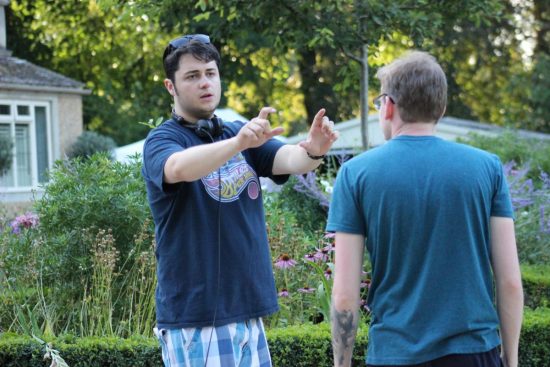
Going back to you style there, what were your influences for the style and look of the film?
I mention Layer Cake before which is something I referenced as soon as I picked up the script and pitched it to Linda and James. Funnily enough, they told me afterwards because I mentioned that they brought me on board, so that was a big influence. But for me personally, as a director, I’m very much classic Hollywood; (Steven) Spielberg, (Robert) Zemeckis, (Martin) Scorsese. I love using camera within a space consistently and understanding that if you are moving actors around you don’t necessarily have to move the camera as much. You can create really interesting compositions on screen and do interesting things with the camera, every single thing you are doing with the camera has to have a purpose. I think we will sometimes see the camera move for the sake of it, but I am someone who unless you are tracking someone across I want to have a motivation for that camera movement. Very early on you will see when Jess is introduced for the first time at a very low angle, pushing forward a little bit and moving up. It is very short, but it establishes who she is really quickly. It’s basic film stuff, but I think sometimes we lose a bit of that in quite gritty movies, not just gangster films but we get that inherent shaky camera all the time where we can’t really see what’s going on. We do have some freehand camera stuff, but I try to use it where I feel it is most important. Everything else is more dramatic close-ups, really establishing wide shots, using the environments and making those look good.
I like symmetry, again another reference to me I am a big fan a lot of Wes Andersons work and he is so good at building the frame. The term of Mise-en-Scène, what’s in the frame that was really important, we couldn’t get it one hundred percent of the time, but at least eighty, ninety percent of the time. Just trying to be much more aware at the time in the scene, the frame and what’s happening in the background and trying to make all of that click together visually was really important to me.
Do you have any other projects which you are working on at the moment?
Film related stuff no, but I would like to make another film. It is very difficult at this stage to chase that sort of stuff, but I am open and would love to work on a buddy comedy, Rush Hour 2 (2001) style, action-packed buddy cop comedy or something along those lines. I re-watched The Nice Guys (2016) recently and I absolutely loved that film. I am a game designer, so a lot of my time is that I am designing video games for a living.
For anyone who may be looking to get into directing themselves feature, what advice would you give them?
Just start making movies I think that’s really important, look at a lot of films and figure out what you like about them, why you think they work and try to replicate the things that you like. If you like a specific camera shot, try and make that within your own story. Being a director, you are steering a ship but a lot of what you rely on is the performances to synergise with the cinematic side of it. I think there’s a language to the camera, there’s a language to sound, there’s a language to performance, there’s a language to space, lighting. You have to have a basic understanding of those. Just research a much as you can and just try it out, make films with your friends, don’t worry about it. Learn how to edit as well, I think it is really important to understand how the film you are recording is going to fit together because that will change how you film things. Once you understand how an edit works you’ll understand how shots will link together and you will have a much better understanding of what you can do creatively to grow that vision. Just do is my best advice, but research it as well.

Published in various websites, Philip is a reviewer who is best known for his interviews and media coverage of independent projects including; films, books, theatre and live events. Always on the lookout for something different to cover!