Amid controversy over his comments on Superhero Cinema, Martin Scorsese returns with a gangster epic that reunites some familiar faces in The Irishman.
When details began to emerge about The Irishman, or I Hear You Paint Houses as it is titled on screen, it seemed that we were about to witness the greatest gangster film ever made. Scorsese already has two films that could easily stake their claim in Goodfellas and Casino, both of which starred Robert De Niro and Joe Pesci with whom he reunites here. Added to the mix are Harvey Keitel and Al Pacino, the latter having taken the lead in The Godfather trilogy. Furthermore, we were told that the advances in digital de-ageing technology would allow the actors to portray their characters at various stages of their lives, meaning that the film could theoretically span decades. With all this potential it seemed somewhat odd that the film would be released by Netflix meaning it would forgo a wide cinematic release. The decision to go down the streaming route seems to have been a financial one with the studios baulking at the projected budget of over $150 million. Netflix has seemingly bottomless pockets and crucially is known for allowing its directors’ creative freedom that is seldom found in the studio system. The question became what would Scorsese do with limitless resources and a cast to die for? The answer is something quite different from what you might have expected.
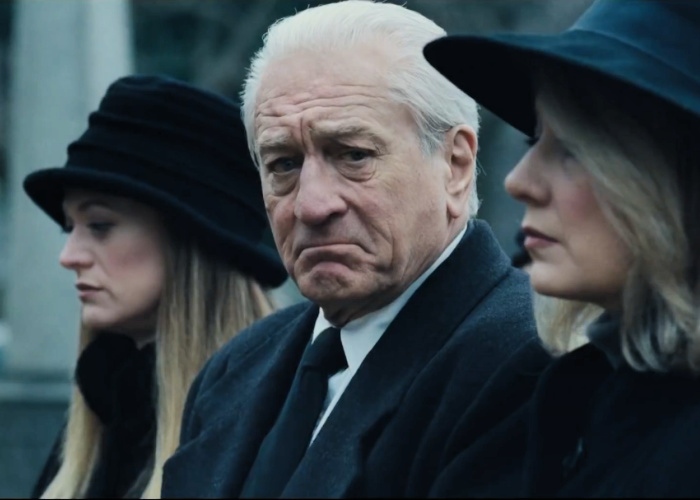
The Irishman is not simply a re-tread of Goodfellas though it does share some DNA with that film. Nor is it the definitive gangster film we might have expected though there is no shortage of criminality and violence. The film is instead a character piece that deals with ageing and regrets through the eyes of De Niro’s Frank Sheeran, a mob enforcer whose life becomes entwined with that of Pacino’s Jimmy Hoffa. The film employs a double framing device as we initially meet Frank as an old man in a retirement home, where he begins to tell a story about how he and Pesci’s Russell Bufalino once took a road trip to a wedding. It is during this road trip that we flashback again to see the story of how the men met, and eventually the context of the trip itself. This structure is what necessitated the de-ageing that has been at the forefront of discussion about the film and the results are interesting. First of all, it is a tremendous achievement and though initially glaring, the effects can be overlooked once you become immersed in the story. There are however some niggles that prove as with so much digital work, we are not quite photo-real yet. Both Pacino and Pesci come off very well with them resembling themselves from earlier in their careers, Pacino particularly looks for all this world like he has just finished filming The Godfather, part three (1990). De Niro himself is a somewhat stranger case. We see him as a younger man and it is certainly believable, yet he doesn’t resemble what he himself looked like at the ages portrayed. De Niro today is a little fuller in the face than he once was, a touch more hunched than the man who starred in Goodfellas, and as such we see a younger version of who he is now, not a recreation of what he looked like then. It’s a distinction that draws attention to the effect rather than the performance which is a shame as De Niro is at his best in years here. Another issue with the de-ageing is the way the characters move, it is clear that we are seeing older men being made to look younger as all three leads are that bit slower than you might expect. It’s not a deal-breaker but it does show the effects are not quite perfect yet and one wonders if body doubles would have been a better choice, particularly for the action scenes.
Where the film succeeds in telling its story, here Scorsese shows that he is still a filmmaking force to be reckoned with. From the Steadicam opening that finds Frank sitting in a retirement home to the brilliant montage of him disposing of his weapons, Scorsese’s camerawork is as crisp and precise as ever. The evocation of the past also is admirable, the vehicles and buildings look like they belong in a film of years past, evoking Hollywood’s golden age, while showing America’s underbelly. A sequence where gleaming yellow cabs are consumed by roaring flames is a particular standout. It’s not all visual flash, however, as there are a number of scenes where we get to spend time with the characters and see just how strong a cast has been assembled. As well as the expected discussions between mob bosses we also get an injection of humour. One sequence where characters debate the appropriate amount of time to wait when someone is late feels almost Tarantino-like in its irreverence. While in other scenes it is the characters’ silence that is the strongest, Anna Paquin in particular shows that a lot can be done with only a little dialogue. When the violence comes it is shot in an efficient, almost clinical manner that does not glamorise the lifestyle in the slightest. This is a theme that Scorsese has explored before but here he does so to a much larger extent. The closing movements of the film spend a lot of time with Frank nearing the end of his life and the tragic loneliness he feels. It is in these scenes that The Irishman finally feels like it has something new to add to the genre and as such is at its most effective.
The elephant in the room is, of course, the length of the film. At three and a half hours this really is an epic. It is of course fairly common now for mainstream films to clock in at around two to two and a half hours or even longer as was the case with Avengers Endgame which ran to three. Despite this, The Irishman still feels long and one wonders if, had it been made for a wide cinema release it would have been edited down to the three-hour mark. It’s hard to argue a case for cutting it as everything we see has its place but its also clear that the pacing is too slow to keep one fully engaged throughout the running time.
The Irishman then is something of an enigma, on the one hand, it is Scorsese re-treading familiar ground, on the other, it goes far deeper than you might expect. It is overlong but not boring. It is an excellent cinema but not a masterpiece.
The Irishman, something of an enigma
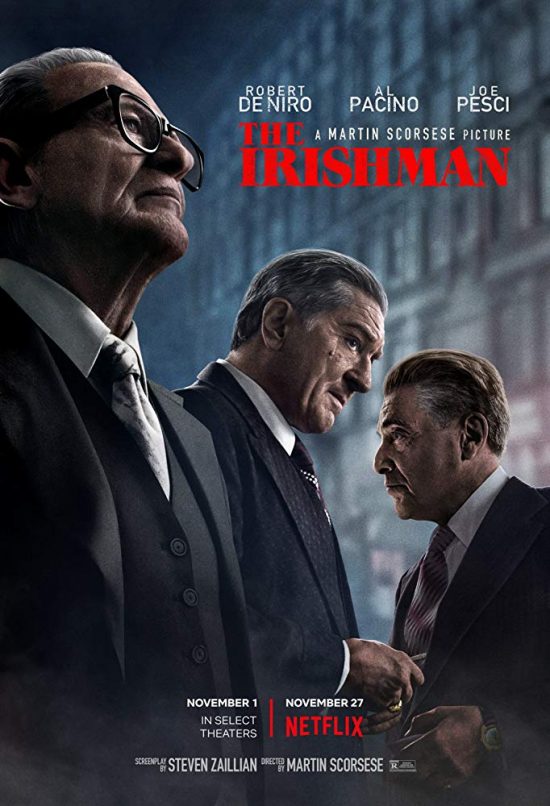
Movie title: The Irishman
Movie description: Martin Scorsese returns to the gangster genre with this tale of the life of Frank Sheeran (Robert De Niro).
Date published: November 8, 2019
Country: USA
Duration: 209 Minutes
Director(s): Martin Scorsese
Actor(s): Robert De Niro, Al Pacino, Joe Pesci
Genre: Biography, Crime, Drama

Jim King is a lifelong geek who enjoys talking about anything and everything out of the ordinary. He co-hosts a Star Trek podcast and is pretty good at Street Fighter 2.