I recently watched through a box set of all the Nightmare on Elm Street films up to number 7, some of which I’d never seen before … so here’s a perspective on them.
A Nightmare on Elm Street (1984) – $25,504,513 USA/Canada – #5

The original and by far the best of the franchise. But then this is so often the case. The first film touches a nerve and exploits it marvelously. We follow a teenager, Nancy (Heather Langencamp), who along with her friends is plagued with bad dreams. In their dreams there is a man wearing a hat and red and green striped sweater, and with a glove of razors on his hand. He torments the kids, and, when they fall asleep, is then able to physically attack and kill them. Nancy realizes this and so decides to set a trap for Fred Krueger (Robert Englund) and to try and pull him out of her dream so he can be killed. This is successful – she thinks – but as she joins her back-alive friends in their car and they drive off, she realizes that she is still in the nightmare.
This film works so well on many levels. Nancy is not a drop-dead gorgeous teen as many of these films seem to feature, but a fairly plain ‘normal girl’, but she has the smarts to try and tackle Fred at his own game. The effects are imaginative and good and the film follows a solid logic, that Fred only attacks when you fall asleep. There’s a nice role for a young Johnny Depp here, and Robert Englund imbues Fred Krueger with a sense of humour and power, which manage to elevate the creation about other, more standard fare, like the evil Wishmaster or Leprechaun from the films of those names.
A Nightmare on Elm Street 2: Freddy’s Revenge (1985) –$30 million USA only – #4
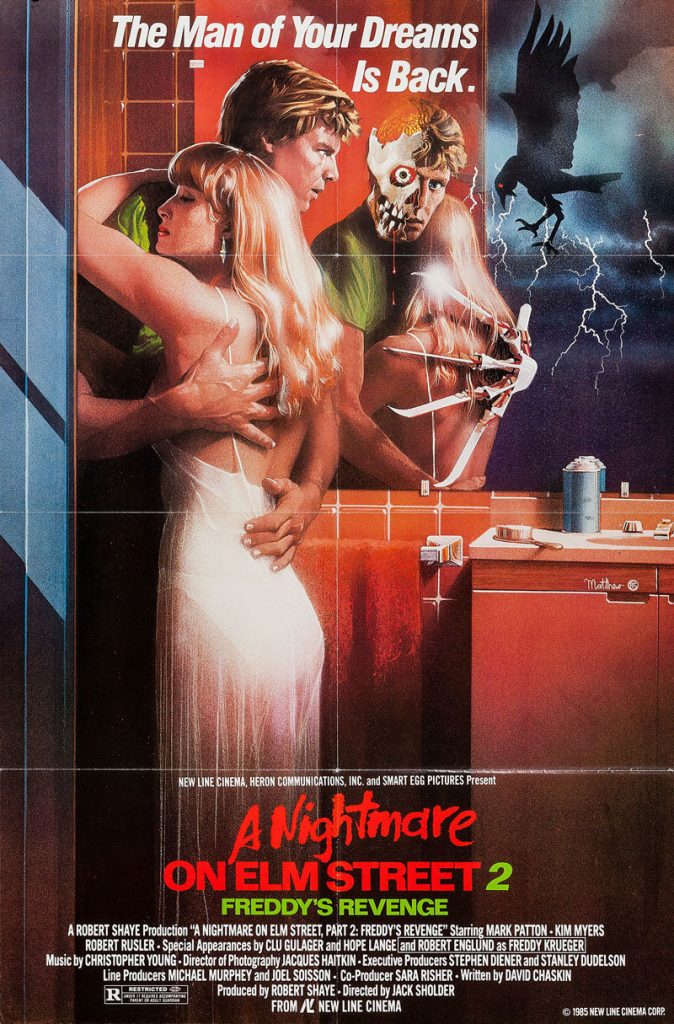
In the sequel, we dispose of all the characters from the first film (except Fred, now called Freddie) and instead follow Jesse Walsh (Mark Patton), who has moved with his family into the house from the first film. He is having bad dreams, and when he discovers Nancy’s diary, he realizes what is happening. But here Freddie is actually possessing Jesse and using him to kill everyone else. There’s a pool party where Jesse/Freddie goes on the rampage killing everyone in sight. In the end, Jesse’s girlfriend Lisa (Kim Myers), professes her love for Jesse which makes Freddie ‘die’ and release Jesse. But the whole thing ends with another dreamscape nightmare: Jesse and Lisa are not really free after all.
After the first film, this is a bit of a shock. Logic is thrown out the window as Freddie can appear in daylight in front of loads of people who are not asleep – and you don’t even need to be asleep to summon him. This pulls this film down to the level of any number of forgettable slasher films and to be honest, it’s amazing that the franchise survived this film. On the basis of the script and production, this was dire, and to be honest the whole thing deserved to die on its back.
A Nightmare on Elm Street 3: Dream Warriors (1987) – $44,793,222 USA only – #2
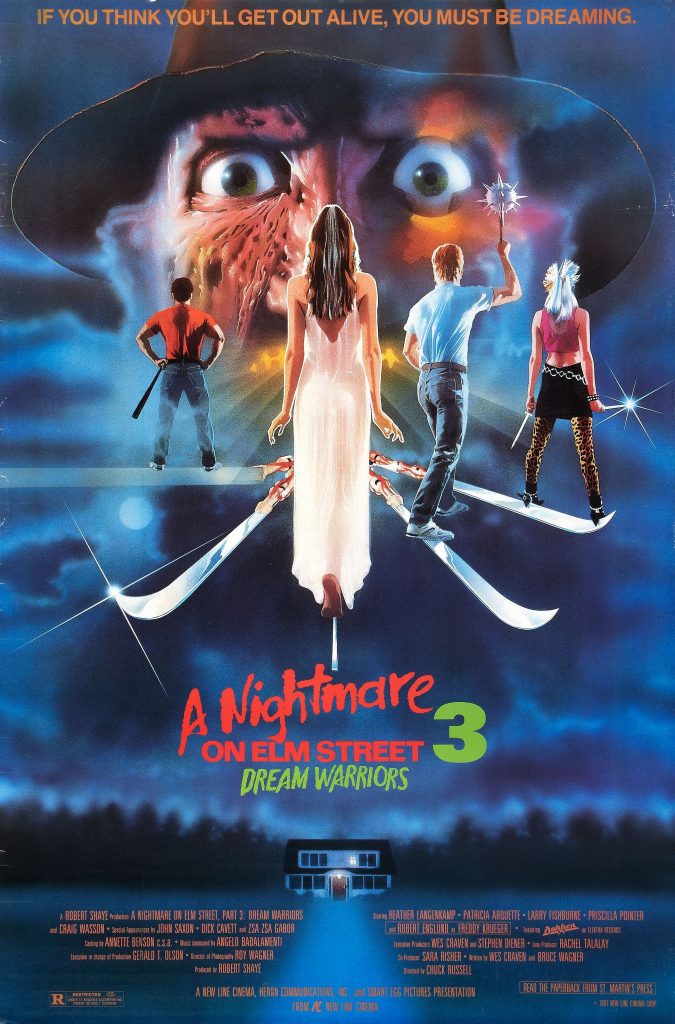
Two years later and Freddie is back, in a much better and more consistent sequel to the first film. Nancy (Heather Langencamp) is now grown up and a counsellor so she’s interested when a group of kids in a psychiatric hospital are claiming to be having bad dreams about a man with a razor glove. She takes them on and discovers that Freddie is trying to claw his way back to reality. So she helps the kids to organize, and to find their own powers in order to destroy the child killer. Luckily one of the kids has the power to summon others into her own dreams, which is helpful!
There’s some great effects here, nicely realized, and because the whole thing is more logical, it works far better than number two. We learn here that Freddie is actually the bastard son of 100 maniacs, and that his mother was a nun who was raped by the lunatics. It’s not clear how they can all be Freddie’s father, or why the insanity of whichever one was the father rubs off onto the son … or how the fact that his mother was a nun has any relevance at all … it all smacks of trying to add backstory where none was needed, a problem that also plagued the Rob Zombie Halloween remakes.
A Nightmare on Elm Street 4: The Dream Master (1988) – $49,369,899 USA only #1
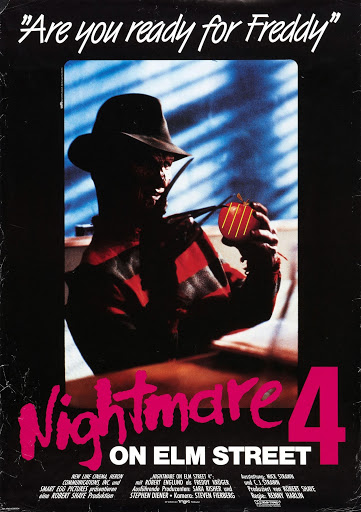
Made back to back with number 3, this entry follows the three kids from number 3, Kristen (Tuesday Knight), Kincaid (Ken Sagoes) and Joey (Rodney Eastman) as they realize that Freddie is again coming for them. Everyone seems to die, but Kirsten’s boyfriend’s sister, Alice (Lisa Wilcox), discovers that she is inheriting the powers from everyone who dies. The climax comes in an old church as Freddie tries to manifest, but Alice stops him, forcing him to look at his own reflection which destroys him.
With some more great effects including a girl-into-roach concept from Screaming Mad George which is just insane, the film manages to entertain on not very much plot. There’s a lot of characters and a lot of running about, but not much in the way of any progression. At this point the films have devolved into a ‘kill as many kids as you can, inventively as you can’ which might make for an entertaining night in with beer and pizza, but which doesn’t make for a very lucid or thought provoking film. It’s increasingly hard to see why on earth this jumper-wearing, heat scarred, glove wielding maniac ever became as popular as he did! That this is the top USA grossing entry in the series is incredible! More people apparently saw this than saw the original film!
A Nightmare on Elm Street 5: The Dream Child (1989) – $22.1 million USA – #6
We follow Alice (Lisa Wilcox) as she has a second battle with Freddie, but this time it’s all about Alice’s unborn baby whom Freddie is trying to control and possess. It’s not clear what a baby actually dreams about – it’s stated that unborn children do dream, but not about what … they have no experiences or even visuals to draw upon. Into this comes Freddie’s mother (Beatrice Boepple) as a ghost trapped in a tower, some more great effects, and another cast of faceless kids to be inventively killed.
The film is something of a mess, hard to follow and it’s actually amazing that the story is by acclaimed horror novelists John Skipp and Craig Spector along with Leslie Bohem, with Bohem alone credited on the screenplay. There’s some interesting comic stuff here, which would have been good if Ah Ha hadn’t got their first with their video for ‘Take on Me’ (1985). The slow development and improvement of the practical effects can be seen, and there’s lots of cool ideas, but fundamentally the film is the same as all the others!
Freddy’s Dead: The Final Nightmare (1991) – $34.9 million USA – #3
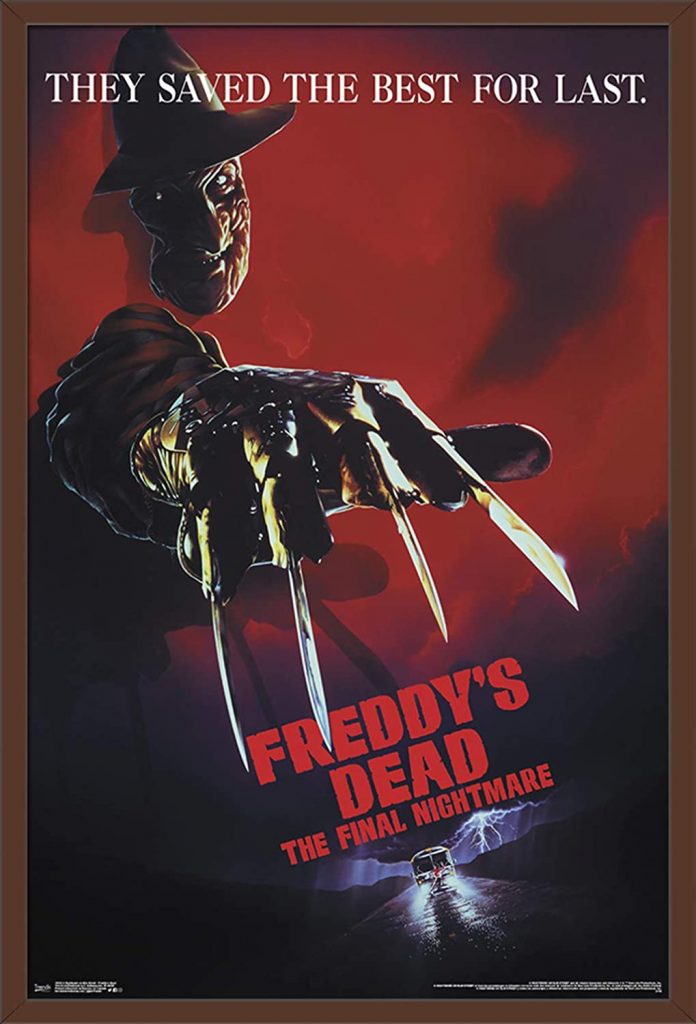
They lied! This isn’t the final film as they went and made more! Unfortunately this entry is saddled with an even more incomprehensible plot and more flights of fancy, and it also has a great big 3D chunk at the end (and an on-screen hint to put your 3D specs on now!). Rachel Talalay who is a great champion of the franchise, both directed and wrote this entry, and unfortunately it’s really not good. We’re supposedly ten years after the first film, and Freddie (Robert Englund) has basically killed every teenager in his home town (Springwood, Ohio). There is one survivor, John (Shon Greenblatt), who loses his memory and teams up with three out-of-town kids, Spencer (Breckin Meyer), Carlos (Ricky Dean Logan), and Tracy (Lezlie Deane). They end up at Freddie’s old home along with their doctor, Maggie Burroughs (Lisa Zane). It turns out that Maggie is Freddie’s daughter (the little girl we’ve seen at points in several of the films), and at the end, Maggie kills Freddie for good with a pipe bomb, releasing the souls he had trapped within him and which gave him power.
It’s a mess of a film and even manages to be boring. There’s lots of running about and trying to escape from Freddie, some good sets and ideas, but little plot to hang it all together successfully. There’s guest appearances from Johnny Depp as Guy on TV (credited as Oprah Noodlemantra), Roseanne Barr as Ethel (credited as Mrs Tom Arnold), Tom Arnold as Childless Man and even Alice Cooper as Edward Underwood. But none of this can save it. This was intended to have been the final Nightmare film, and perhaps it should have stayed that way …
Wes Craven’s New Nightmare (1994) – gross $19.8 million – #7
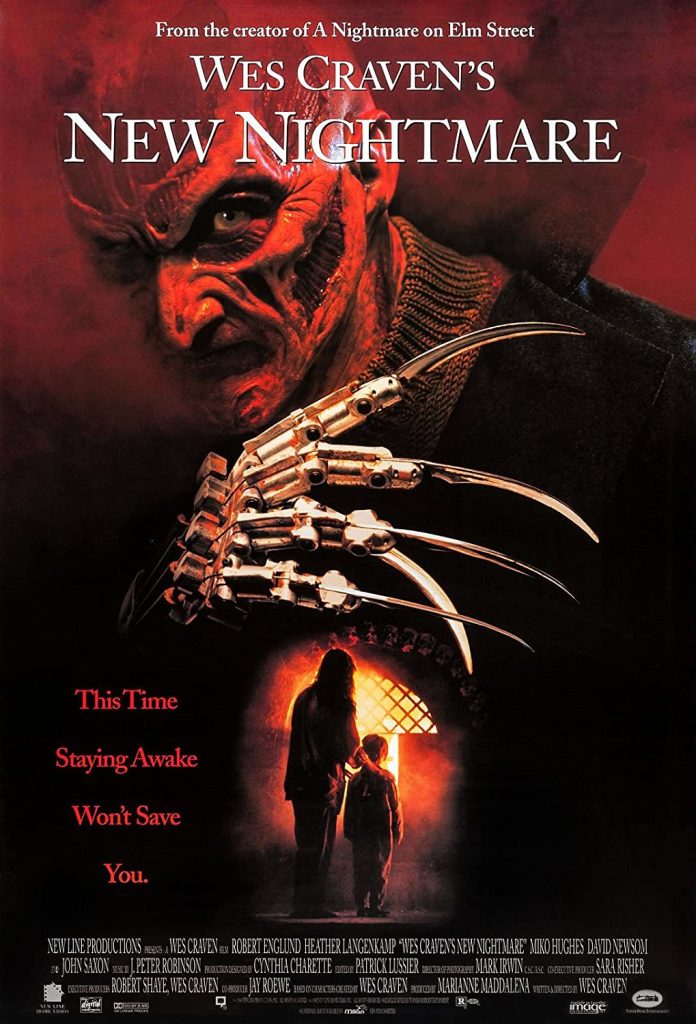
And so we reach the end of the box set. And this film which claimed to ‘reset’ the films back to what Wes Craven intended. Well, it’s interesting that it’s the lowest-grossing of all seven of the films, and what’s more, it’s actually boring. What Craven has done, is to go meta, and to make a film about the films. Wes Craven’s New Nightmare follows Heather Langencamp, playing Heather Langencamp, and her young son Dylan (Miko Hughes), as New World Pictures tries to interest her in playing Nancy once more in another Nightmare film. There are the actors playing themselves (Robert Englund, John Saxon) and also crew playing themselves (Wes Craven, Robert Shaye), and somewhere in the midst of all this, Freddie (Robert Englund) is revealed to be really real, and coming back to kill everyone in real life as he’s no longer confined to the films.
But the main issue with the film is similar to some of the earlier ones, in that the logic is all over the place. If Freddie can only attack you when you are dreaming, then how come he can attack and kill characters like the babysitter Julie (Tracy Middendorf) when she is not dreaming (but Dylan was?). It’s all puzzling and meta with Heather/Nancy gets a copy of Wes’ script for the film that she is actually in, and reads lines and scenes from it as they are happening (ie the script says she has a copy of the script and reads it etc).
The climax takes place in a dreamscape of ovens and horror and water, and Heather/Nancy and Dylan have to try and kill the maniac before he can kill Dylan and return to corporeality for good. They seem to achieve this, and Freddie explodes, destroying the dreamworld and ejecting Heather and Dylan back to reality and trapping Freddie again in the world of make believe.
I suppose it’s not a bad way to end the series, but was the film even needed at all?
The Franchise
What interests me most here is how the character of Freddie Krueger (just Fred in the first film) became so massive and popular that it seemed to transcend the films and took on almost mythical status itself. You could buy Halloween Freddie outfits, plastic blade-gloves, burnt face masks … all stuff for young kids … except that this character is a child-killer. A murderer with no remorse and no compunction, and appearing in films which kids had no right to see in the first place! I remember being surprised when this all happened, but it never seemed to stop.
And all this popularity took place while the series of films which supported the backbone of the franchise got worse and worse …
After this film, there was one more in the original series, Freddie Vs Jason (2003), which is perhaps the most unlikely pairing of all. Two of these semi-mythical killers matched together. Freddie, we have discussed, but Jason is the hockey-masked, machete-wielding maniac from the Friday the Thirteenth film franchise (itself comprising 11 films) and bizarrely, in the first film, he is not even the killer (spoilers … it’s his mum!).
Both franchises attempted a reboot. Nightmare in 2010 and Friday in 2009, and both failed to generate any further films. And both enjoyed a same-named TV series. Freddie’s Nightmares (44 episodes, 1988-1990) which was hosted by Krueger and occasionally explored backstory and themes from the films, and Friday the 13th: The Series (72 episodes, 1987-1990) which was associated by name only, having nothing whatsoever to do with the films or any of the characters in them.
Finally, as a coda, here are some interesting stats from Wikipedia on the relative performances of all the main ‘Franchise’ series of horror movies:
When comparing A Nightmare on Elm Street with the other top-grossing horror series—Child’s Play, Friday the 13th, Halloween, the Hannibal Lecter series, Psycho, Saw, Scream, and The Texas Chainsaw Massacre—and adjusting for the 2010 inflation, A Nightmare on Elm Street is the third highest-grossing horror series, in the United States, at approximately $583.4 million. The series is topped by Friday the 13th at $671.5 million. A Nightmare on Elm Street is after the Halloween series with $620.4 million, then Hannibal Lecter series with $579.4 million, Saw with $404.5 million, Scream with $398.3 million, Psycho with $370.3 million, The Texas Chainsaw Massacre with $314.6 million, and the Child’s Play film series rounding out the list with approximately $199.7 million.
PS: We’ve illustrated this piece with several posters of the Nightmare films found on the internet. It’s near-impossible to say if any are ‘fan-made’ rather than official, so apologies if we’ve used someone’s work by mistake!

David J Howe, is the author and co-author of numerous books about the TV Show “Doctor Who”, as well as being a freelance writer and Editorial Director of Telos Publishing Ltd.