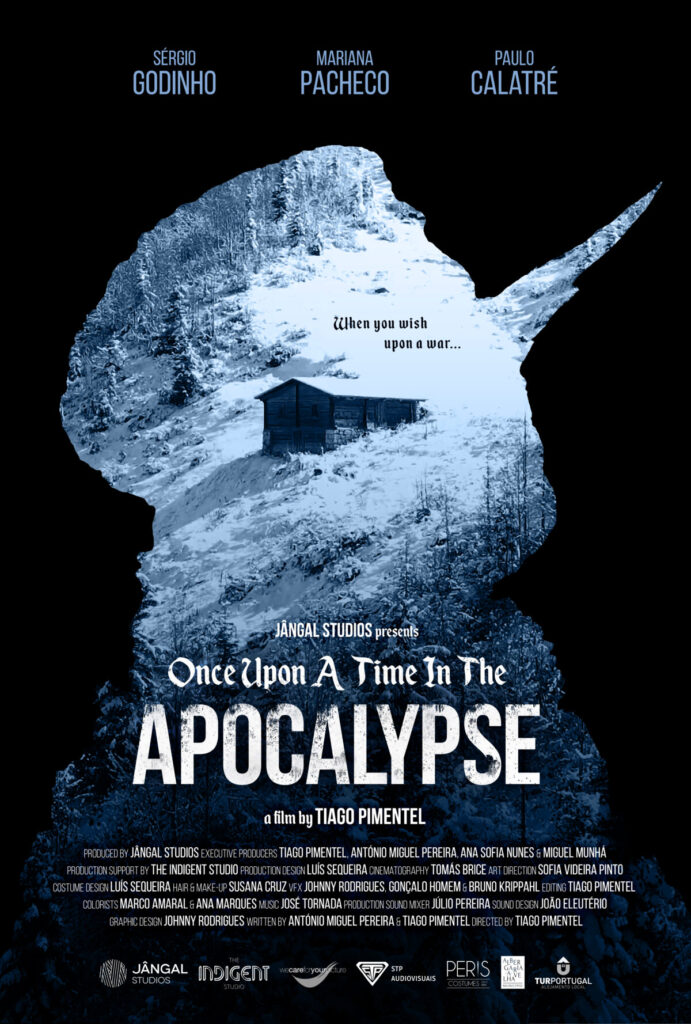
Film Name: Once Upon a Time in the Apocalypse
Director: Tiago Pimentel
Writers: António Miguel Pereira, Tiago Pimentel
Starring: Paulo Calatré, Sérgio Godinho, Mariana Pacheco
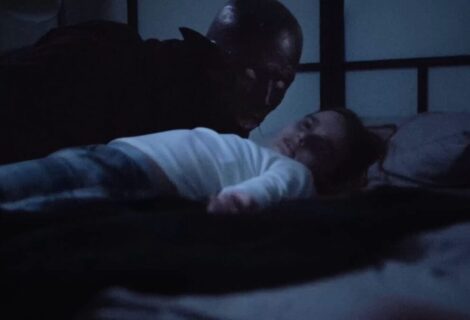
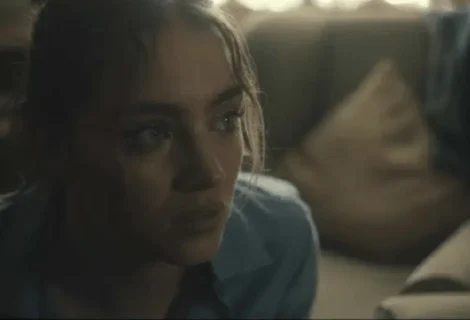
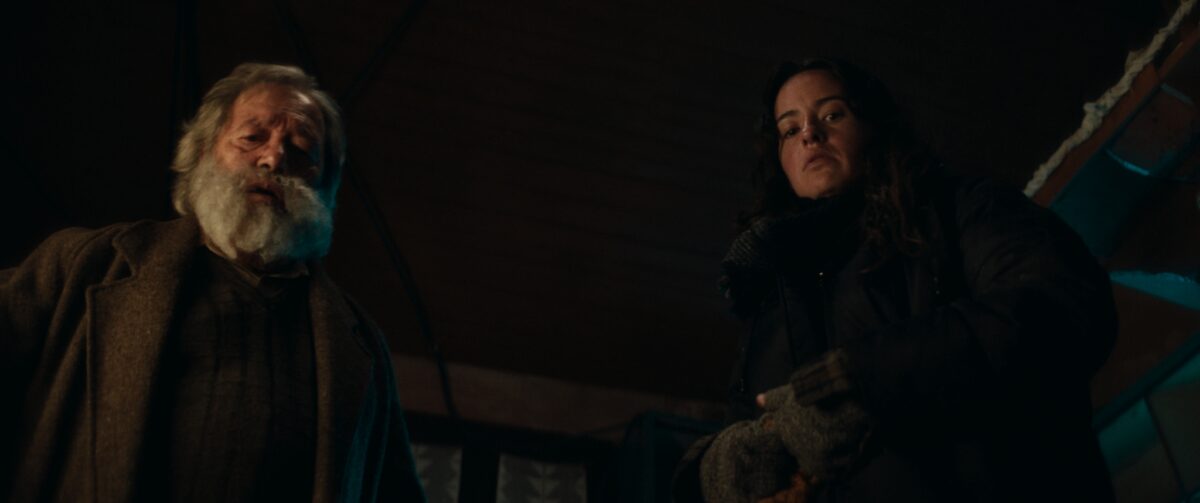
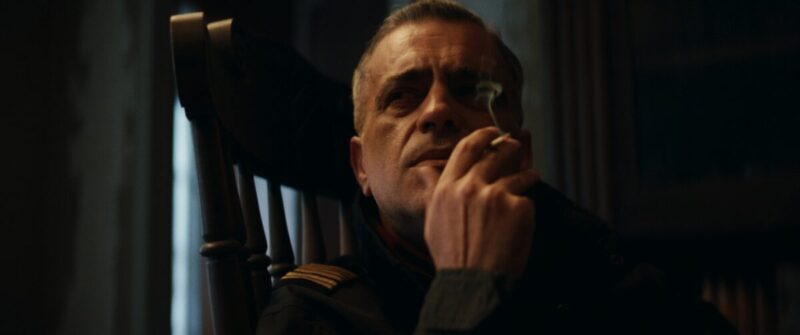
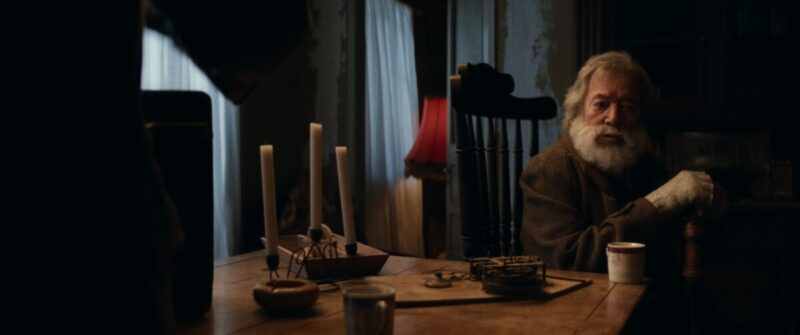
In the aftermath of a nuclear war, totalitarian regimes disrupt world order. Ernesto is hiding a secret, and when a government inspector shows up at his doorstep a cat and mouse game unfolds that can only end in tragedy.
In a new exclusive interview on Blazing Minds, I had the chance to ask Co-Writer/Director Tiago Pimentel and Co-Writer António Miguel Pereira a few questions about their film ‘Once Upon a Time in the Apocalypse’, which played at Horror-on-Sea.
Q. Your film Once Upon a Time in the Apocalypse has been selected to play at the Horror-on-Sea Film Festival. Can you tell us what we can expect?
Tiago Pimentel (TP). The audience can expect a dark, dystopian film with a very carefully crafted aesthetic, and above all a story that searches for a glimmer of hope and humanism in a post- apocalyptic world. Its reality seems larger than what is shown on screen, which helps to captivate the audience’s imagination.
Q. You co-wrote the script with António Miguel Pereira. What were some of your inspirations when writing the script and what was your process for writing together?
TP. António and I have already written several projects together, and this one initially came from our desire to do an exercise in suspense and horror. It quickly evolved into something bigger and denser, with a more human subplot than we had originally imagined. I think that at a certain point the inspiration from Inglourious Basterds (2009) by Tarantino became inevitable in our minds, but only formally… in the setup. This is a Once Upon a Time story in its essence, with the contradictions one would expect from its apocalyptic context.
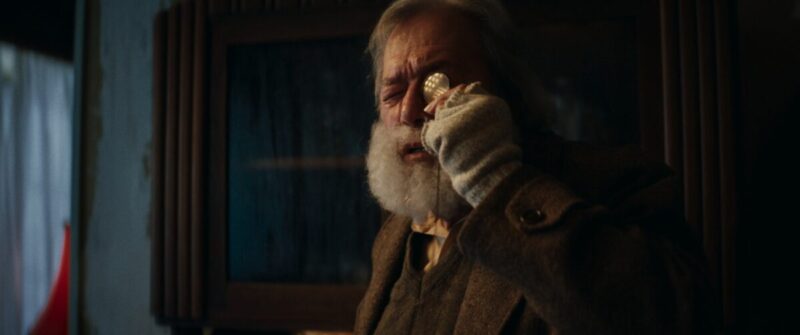
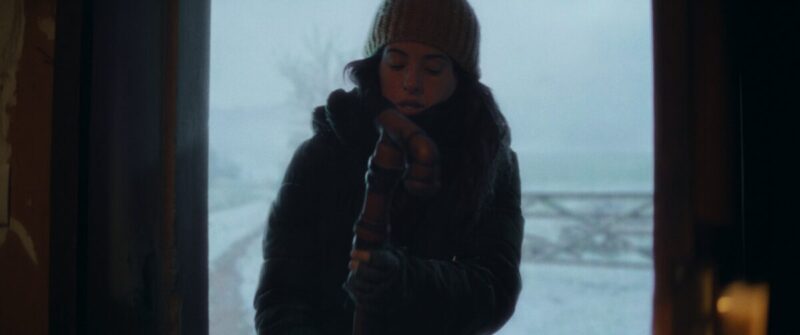
António Miguel Pereira (AMP). To answer the last part of your question concerning the writing process, Tiago is more visual and I tend to obsess over narrative cohesion and the story’s internal logic. While we don’t always agree, we complement (and sometimes even compliment) each other as writers, as we both feel the end result is better than the sum of its parts. Regarding inspirations, I recall A Quiet Place (2018) being an early spark, as we wanted to emulate its focused premise of a family – in our case, a man and his pregnant wife – barricaded in their own home as the apocalypse raged outside. It started that simply. But when we had the idea of casting legendary protest singer- songwriter Sérgio Godinho, the narrative evolved into a father and daughter surviving as scavengers in a snowy post-nuclear wasteland. Then, as we developed the antagonist, the opening scene from Inglourious Basterds asserted itself, and thus Colonel Salavisa was born. Finally, when deciding how to resolve that character’s arc, we independently arrived at the same far-out idea, which was absolutely crazy. And that eventually steered the story toward a dark fable reminiscent of Pinocchio.
Q. Did you have any of the cast in mind for the characters when writing the script?
TP. When we started writing, no. Halfway through, yes. As António was saying, the character of Ernesto was crafted specifically for the great Sérgio Godinho, one of the most respected names in Portuguese culture. But as we finished the script, I secretly realised I was going to have a big problem casting the role of the Colonel. I had worked with Paulo Calatré on a series (Projeto Delta), and in my mind he was the only one who could bring such an intimidating presence while still being completely believable. Thankfully, he accepted…
Q. What were some of your influences for the look and style of the film?
TP. I had a long conversation with the DoP (Tomás Brice), and we both wanted an intimate aesthetic—something that would place the audience inside that house with Ernesto and his daughter Helena. Indoors, it was important to feel the warm yellow light of the lamps heating the old wood. Outside, everything was blue and cold. The exterior world was dangerous, and it was essential to feel that danger when the Colonel finally enters the house. It was important that even in the cinematography—whether through light or colour—the contradictions between the charm of a fable and the coldness and darkness of a horror film could be felt.
AMP. We also enjoyed the privilege of having master designer and two-time Academy Award nominee Luis Sequeira (The Shape of Water, Nightmare Alley, Welcome to Derry) handle costume and production design for this short. We had wanted to work with him for a while and this time that collaboration materialized – and to spectacular effect, I must say. He advanced our world-building and helped shape its fantastic yet desolate atmosphere by defining the characters through their wardrobe and transforming the derelict house we filmed in into a veritable refuge – one that felt both decaying and comforting.
Q. Did you make any changes from the original script during filming?
TP. Very few. The ones we made came from suggestions by the actors. We had already done script readings, and the changes we identified were made in advance. We had very little time during the shoot, so it was imperative that everything was as finalised as possible.
AMP. We did, however, find ourselves short on time in the second and final day of shooting in the house, which led us to streamline some of the coverage, specifically when the Colonel arrives at the house. We also pivoted from practical to visual effects for the death scene. While born out of necessity, it ultimately allowed us to fine-tune that moment in post-production to ensure it landed with greater impact. Just another day at the office when working on microbudget productions.
Q. What were some of your favourite moments during filming?
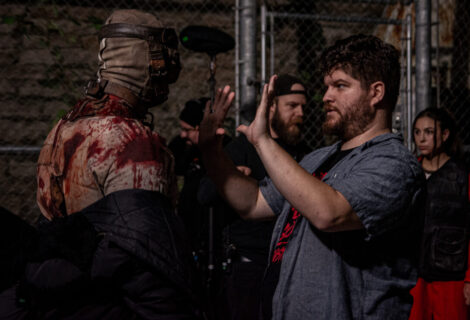
TP. Without a doubt, the ‘oners’ (long takes). As a director, I love all aspects of filmmaking, but I must admit that the choreography between the actors, the action, and the camera fascinates me.
AMP. I really liked the set dressing process. But watching Paulo Calatré bring Colonel Salavisa to life with such restrained ferocity was a highlight. He gave me chills!
Q. Did you experience any issues during filming?
TP. At one point, a lady wanted to come onto the set. She was extremely angry (and rightfully so) because we had driven the production van over a cultivated area (we didn’t know). It was very difficult to manage the situation, but our producers (Miguel and Ana) were decisive. Their professionalism was impressive. Other than that, everything went very well. The usual lack of time, but that’s to be expected on a low-budget film.
AMP. By the end of Day 2 the crew’s fatigue was beginning to show – we did this over an intense weekend – and there was a moment when it seemed we might not be able to wrap up the remaining shots due to the long hours. Fortunately, the team ended up walking that extra mile with us and made it happen. Their resilience is visible on screen.
Q. What makes Once Upon a Time in the Apocalypse stand out as something different in the horror genre?
TP. It’s a film that doesn’t aim to scare. I’ve never been a big fan of jump scares—they feel like cheating to me. In a cinema, any loud sound can trigger an instinctive reaction in our bodies. What interests me more is discomfort. I want to hold the audience’s breath, not just through visual language and the soundscape, but also through empathy for the characters and their story. This film is an experience. It places us in that house, in that context, with those characters. It was a film designed to be seen in a cinema.
AMP. I believe we managed to address complex themes of grief, love, and trust in times of war in a sensible manner while keeping the narrative tense and gripping. It works as a cautionary tale about the horrors of war, which is one of the most grounded kinds of horror. It is sadly a very pressing concern – just a week ago, as the film was having a theatrical run at the Roxie in San Francisco, the military intervention in Venezuela unfolded and suddenly the world was discussing the invasion of Greenland and the end of NATO. When we set out to write this short in early 2023, spurred by Russia’s invasion of Ukraine, we had no idea how much it would come to reflect the current state of affairs. It now seems less like fantasy and more like a dreaded premonition…
Q. What do you hope people take away after watching the film?
TP. I hope for everything except indifference. I get sad when people say the film was ‘nice.’ I’d rather hear that they hated it. I hope they feel the experience and, for 20 minutes, immerse themselves in that world and understand the story of those characters. And I hope they sense that, despite everything, there is a fable within that story.
AMP. Being a fable, there’s an underlying message. Hopefully, the audience will pick it up.
Q. Do you have any other projects which you are currently working on?
TP. (laughs) We don’t lack projects, what we really lack is funding. Making films in such a small country becomes ungrateful, due to the difficulty of making a project as expensive as a feature film or a series viable. But we are currently writing a series set in a hotel and a feature film that is an existential political thriller (laughs).
Q. If someone was looking to write and direct their own film what advice would you give them?
TP. You have to add ‘produce’ to that list. When no one knows you and you want to get funding to write and direct your own film, you have to accept that you will also be the producer. No one is going to give you money at the start. At least, no one gave me any (laughs). In my country, we’re fortunate to have public funding that allows us to do some things (it allowed me to make a series).
The rest is a learning process. There’s no film school that can replace the creative arena of a film set.
AMP. You really need to find like-minded people that are starting out – ideally in film schools – and willing to go along for the ride. Once you have a compelling story to tell and a team ready to bring it to life, be bold: reach out to one or two established professionals, whether they are actors, cinematographers, or designers. Sometimes, if they like the project, they will accept the invitation just for the love of the craft. That will be an invaluable learning opportunity for you and will also elevate the final quality of your work. Get out there!
Once Upon a Time in the Apocalypse will play at Horror-on-Sea on Friday 23rd January at 15:00hrs.
You can find out more about the festival and purchase tickets here

Published in various websites, Philip is a reviewer who is best known for his interviews and media coverage of independent projects including; films, books, theatre and live events. Always on the lookout for something different to cover!