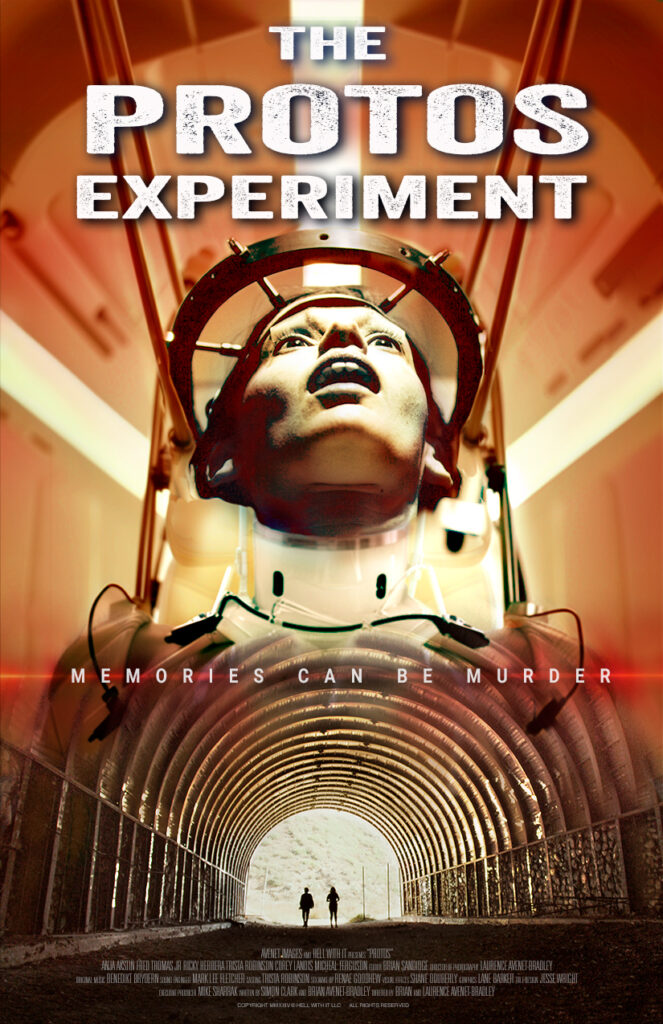
Film Name: The Protos Experiment
Director(s): Brian Avenet-Bradley, Laurence “Lo” Avenet-Bradley
Writer: Brian Avenet-Bradley, Simon Clark
Starring: Anja Akstin, Fred Thomas Jr., Ricky Herrera, Trista Robinson, Corey Landis, Micheal Ferguson
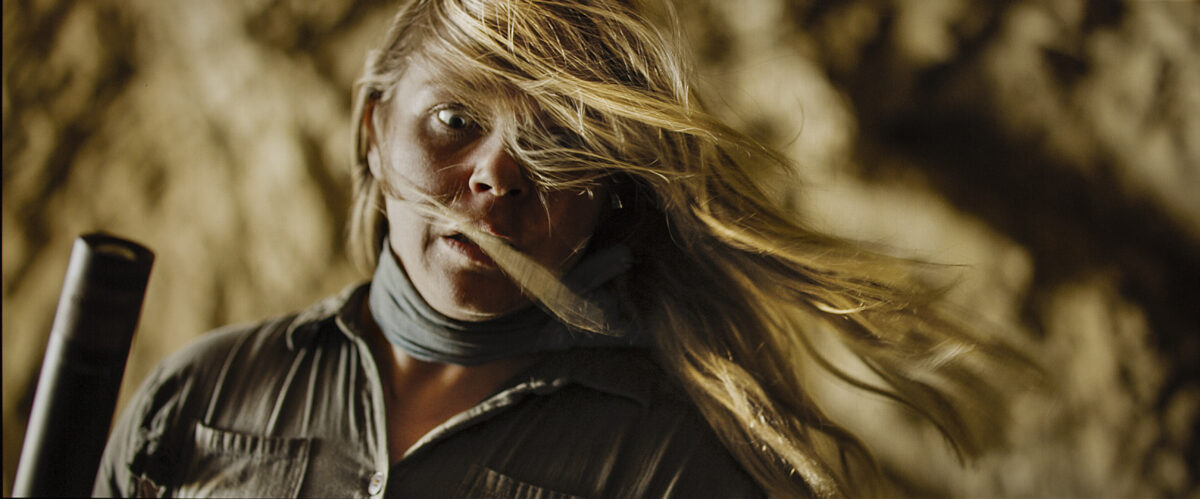
In a dystopian future a scientist uses memory implants to revolutionise the prison system. Four death row inmates must escape or risk losing their minds forever.
In a new Exclusive Interview on Blazing Minds ahead of Horror-on-Sea I got a chance to ask ‘The Protos Experiment‘ Co-Writer/Director Brian Avenet-Bradley & Co-Director Laurence Avenet-Bradley a few questions about the film.
The Protos Experiment will play at Horror-on-Sea on Saturday 18th January at 3.00pm
Q. Your film has been selected to play at the Horror-on-Sea Film Festival. Can you tell us what we can expect from the film?
B: We hope you’ll be thrust into a suspenseful psychological horror film where, like the main characters, you don’t initially understand what is really going on or why. You learn as the characters do. The Protos Experiment has many unexpected turns that keep coming throughout the film that will keep you guessing as to what’s next. For you to really enjoy the film, the best thing is not to know too much about the story before you see it.
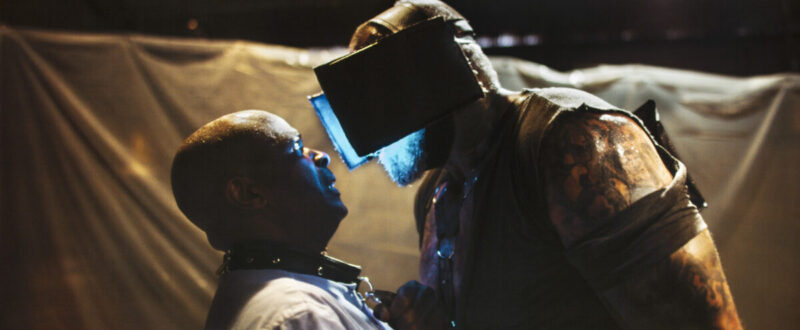
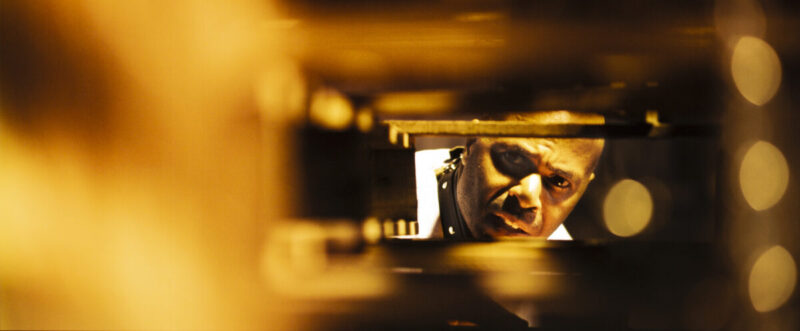
L: Beyond the story, you can expect to see a movie that is visually unique— both from the cinematography perspective, with its dynamic camera work and different lighting looks for all the different scenes— but also with its sets and costumes, including “blinder headsets” that remotely change colour in synch.
B: You’ll also experience striking locations you’ve never seen before. We can guarantee that as multiple locations required hour and half hikes carrying equipment far off the grid to reach. You can feel it when the actors are really there in these environments; their struggle to get there really fits their characters fight to stay alive.
L: We hope the audience experiences a unique thrilling ride that also poses some questions that makes them think about what makes a person who they really are.
Q. You co-directed the film. What is the process of you working together when directing?
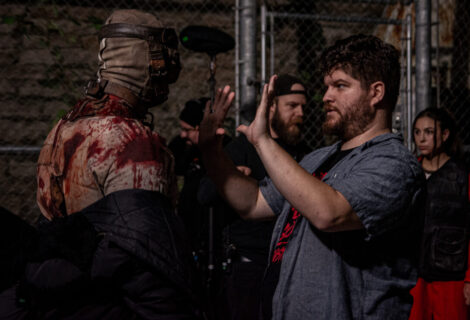
L: We’re a husband and wife filmmaking team, and we’ve collaborated on multiple features together. As a cinematographer and also camera operator, I’ve always been involved in designing out the shots to best tell the story in the scene. To us, that’s a very important part of directing as the flow of the visuals tell the story, so those decisions are key.
B: By the time we start shooting, we’re both on the same page as to what we want so we can communicate in shorthand. We both work with the actors in helping them create their characters prior to shooting and then also direct them on the set together. Because Lo’s also the camera operator, she is often only a couple of feet from the actors— so for her to directly give feedback to them in real time makes the whole filming process go smoother and faster. Since the actors know that we’re both speaking in one creative voice, they appreciate that the co-director/camera operator inches away from them can guide them to give the best performance possible for the lens.
L: Directing on set is really about guiding their performance, keeping their arc consistent and making the most of what unexpectedly emerges from shooting on real locations.
Q. Brian, you co-wrote the script with horror author Simon Clark, who also wrote the novel. How
did you end up collabora4ng on the project and what was the process of you wri4ng together?
B: Julian Richards of Jinga Films is our sales agent for our previous film, ECHOES OF FEAR. And as Lo and I were developing our next film with our fellow producer Mike Sharrak, Julian recommended a script that had just arrived on his desk from Simon Clark. Simon is a prolific UK horror writer with over 40 published novels, but this was his first script. Julian had read it and thought we’d be a perfect fit to make it. Simon’s script was engaging, and when the script ended, we wanted the story to continue. Mike loved it and felt the same way. We spoke with Simon via Zoom, and we explained that we wanted to greatly expand the story and take it much further to explain what was happening in the film— and just as importantly why it was happening. Simon was game, and we worked with him for over a year to flesh the story out and the answer to the story’s mystery revealed itself.
Our process of working together was lots of brain storming sessions on Zooms. Then we would divvy up different scenes for each of us to write. Once we’d finished, we’d swap and the other would take a look at what the other had written and that often led to other ideas. Lo as a co-director was also part of the Zooms and would read all the drafts from us both and came up with crucial ideas— the biggest of these was the actual Protos themselves as they exist in the film. Once the Protos came into being they spread through the script and the whole story fell into place. It was a fantastic experience collaborating with Simon.
Q. What were some of your influences for the look and style of the film?
L: My influences come more from a general horror perspective. In addition to my favourite classics, such as The Shining, John Carpenter’s The Thing, and Blade Runner, I was highly influenced by the feel of the original Resident Evil video game that was remade for Game Cube: the atmospheric motivated lighting to tell a story.
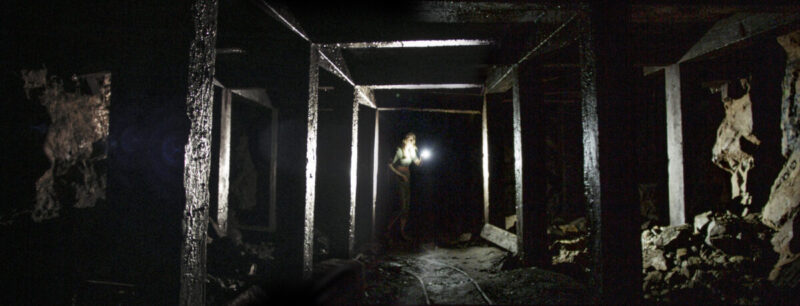
For the Protos Experiment story, I wanted to contrast the feeling of characters being trapped and feeling free. When feeling trapped, the light sources are the control: the blinders, the wood pallet pyramid, the flashlights, the blue light people. Freedom is the sunlight.
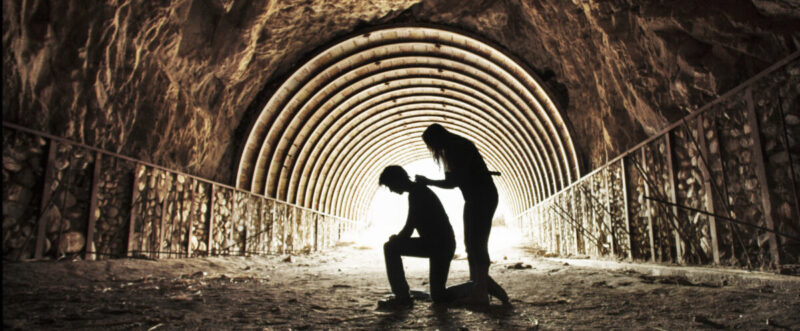
Even when the characters thought to be safe from control inside the walls of the rock tunnel, the drones were coming in to get them. Same as when the sun was setting, the drones were coming. I felt that having camera movements even when the characters were under control would show how that world is unstable, how the characters want to move to get away from the controlled environment.
B: Like Lo, the late 70’s and 80’s horror and science fiction classics are a big influence on me. The Shining, Alien, Halloween, John Carpenter’s the Thing, Blade Runner, Evil Dead, Videodrome… And some of Alfred Hitchcock’s classics were formative as well— Psycho in particular. But all those influences are really internalized from long ago so they’re not something that I directly reference when preparing to shoot a film.
My biggest influence for this particular film were the exterior locations themselves. A lot of these locations we had previously uncovered from long hikes in the desert and the mountains and being in those environments had a strong impact on me. So I really wanted to capture that in a film— but they did not fit our previous film ECHOES OF FEAR, which was a more contained supernatural horror film that took place in a haunted house.
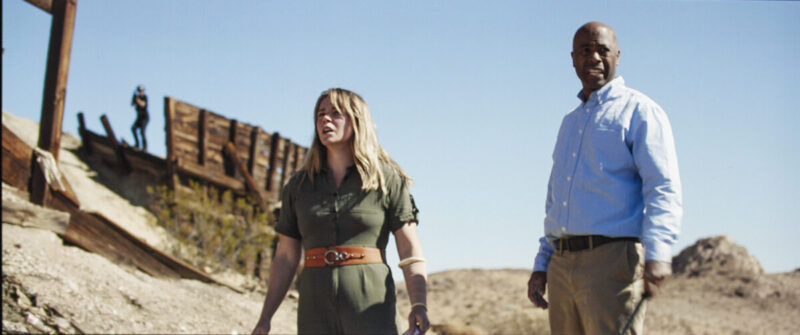
I had written several scripts that tried to utilize these locations, especially the deep underground ones, films that never happened. But when The Protos Experiment came to us from Simon, and we knew we wanted to expand the story, I realized these remote places were a perfect fit— a way of going into new territory in the film and really highlighting their escape attempt. These remote locations were an important reason why we chose a widescreen 2:39 aspect ratio. We wanted to frame the characters in desolate wide vistas that show just how challenging their escape is. They are isolated— just like the locations are.
Q. What were some of your favourite moments during filming?
B: For me, it was shooting the actors in those real remote environments. I’m always inspired by shooting in real locations. And seeing how those locations affected the actors, the performances they gave there and being to capture that on camera— that was magical. One location we filmed at is a massive rock tunnel, that was carved out by convicts, that was supposed to help an entire city flee a nuclear attack by allowing them to drive through the mountain. (It will come as no surprise the tunnel was never finished which is why it’s only accessible on foot.) It’s an absolutely fantastic location which has massive rusted metal plates that hold back the overhead tunnelled rock. Shooting the actors silhouetted against that massive entrance was an amazing moment. Other favourite moments for me was watching Lo shoot those dynamic Steadicam shots with the actors.
L: Working the “pools of light” scene was challenging and exciting— seeing all the “blinder headsets” of the Protos all change change colour simultaneously as they attack, the pools of light getting bigger and smaller within the same shots, and capturing all the action with the Steadicam was thrilling.
Q. Did you experience any issues during filming?
L: The biggest issue we experienced was of our own making— adding into the script so many remote locations over such a wide geographic area. It was not only a logistical nightmare; it was physically gruelling. We’d have to hike to a location for an hour and half with the gear on your back, then we had to hike back after the day’s shooting. That left a very short shoot day which forced us to work very fast and efficiently, but also led us hiking back to the location many Ames to complete all the scenes. But thankfully, everyone was real troopers and stayed safe.
B: Ironically, the one incident that took place was at one of the easier to reach desert locations. We had an arrow with a razor tip and a prop version of it for safety. Our lead actor, Anja Akstin, was in a close up where we had to use the real arrow. We did the shot and she ran out of frame— and being really into it— she continued her movement off camera and accidentally sliced through her leg. She barely brushed the arrow against herself— but with the razor tip, it sliced right through her costume and skin. We all freaked out as the blood flowed. Well, all of us, but her. She’s a Marine and calmly looked at the wound and asked if we had any butterfly bandages— which we did in our medic kit. Lo helped her clean up the wound, and she applied the bandages. We thought that was end of shooting that day, but no, she wanted to finish the rest of it. Her pants legs were blood soaked, but we had a spare outfit. So she changed and we made our shooting day. Then she was back the next morning continuing shooting— sprinting on her leg even though it hurt. We cast her because she was tough, as her character she needed to be, but that was a degree of toughness that blew us away. Once a Marine always a Marine.
L: Once while we were filming, we heard a real Swat team descending outside one of the sets, trying to capture a gunman; we kept rolling inside the studio as choppers thundered overhead. So we had some memorable moments to be sure!
Q. What makes stand out as something different in the horror genre?
B: We think it’s a pretty original story that defies expectations as the mysteries are revealed. It’s rare that you don’t know where a film is going these days, and we think if you haven’t watched the trailer or read any spoilers, The Protos Experiment’s story is a puzzle that’s fun to see unfold.
Because of that, it’s a multi genre blend— it’s a suspenseful mystery, a psychological thriller, a horror film— and then fully introduces another genre in the second act. That reveals the reason why the people are there and what is being done to them and why. And that is very different.
L: I’d also say the Protos themselves— their look, how they function, and why they are what they are
are unique to the film.
Q. What do you hope people take away a]er watching the film?
B: First and foremost, I hope people take away the joy of having a thrilling good time watching the film. Secondly, I hope the visual experience and story lingers with them and gives them some things to think about. What really drew Lo and I to the story from the get go was the element of unreliable and/or missing memories and if you can’t trust your memories, can you even trust yourself and who you think you are. So hopefully some of those themes resonates with audiences and leads to some fun over coffee or online discussions with fellow viewers.
L: I’m also hoping that the themes of the movie linger in people’s minds. I think the movie has something to say about the capitalism of human beings and how people once they’ve been dehumanized can easily be exploited.
Q. Do you have any other projects which you are currently working on?
B: Yes, we’re in development on a supernatural horror film inspired by true events. We’re working on the story now with co-producer Mike Sharrak, and he’s already found the perfect location that’s right in the area where the real events took place. So we’re all excited about how it’s coming together so far.
L: Beyond that, we have an illustrated horror novella, INNARDS, that we recently finished and trying to figure out how to unleash onto the world.
Q. If someone was looking to direct their own film what advice would you give them?
L: Follow your guts and do it!
B: Make sure it’s a film that you’re really passionate about making, that you’re willing to bleed for. It
should feel like a film that you have.
You can find out more about Brian Avenet-Bradley and follow on Facebook and Instagram
The Protos Experiment will play at Horror-on-Sea on Saturday 18th January at 3.00pm
You can find out more about the festival and purchase tickets here

Published in various websites, Philip is a reviewer who is best known for his interviews and media coverage of independent projects including; films, books, theatre and live events. Always on the lookout for something different to cover!