

Following the recent release of Darkness; An anthology of Dark and Twisted Tales from Twisted Fate Publishing, I got a chance to ask writers CM Angus, Gareth Clegg and Nick Stead a few questions about why they chose to write a charity anthology for the charity ‘Mind’, the inspirations for their stories and their collective name of ‘The Sons of the Twisted Fate‘
Q. Who are The Sons of Twisted Fate and how the group first came together?
CM Angus: The Sons of Twisted Fate is a “by invitation only” group of diverse writers of seriously warped speculative fiction, whether that is Horror, Sci-Fi, Fantasy or anything else in between.
The idea for the Sons came from the idea of building a platform for authors to work together to raise awareness of often overlooked good causes and to use their skills to make a difference.
A number of us are extremely fortunate to be plugged into an incredibly vibrant writing scene so doing such an invitation-only project seemed natural – kind of like a super-group of our friends – A Hollywood Vampires of the literary world – and out of that nutshell of an idea was born. The Sons: A gestalt band of established authors who do their own independent things, but also come together to collaborate for a common cause – striking hard before sinking back into the night.
We began pitching the idea for the Sons in late 2019 and a number of us realized that Mental Health was a cause that in many cases was unfortunately still a taboo. At some point in their lives just about everyone goes through challenges where they are battling their own demons and we wanted a way of saying that often it’s darkest before the dawn. From that idea the Darkness anthology was born.
Q. The Sons of Twisted Fate have released a new charity anthology book called ‘Darkness’. Can you tell me a bit about what we can expect from the book?
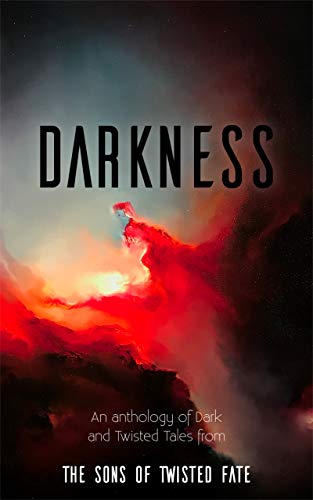
CM Angus: Darkness is a high-quality collection of Speculative Fiction with each piece being on the theme of “Darkness” but interpreted in a number of different ways.
The collection ranges from fantasy worlds of eternal darkness to dystopian Scottish cannibals, from magical visions of Earth’s last hours to the summoning of Hellish beasts.
Not only is there dark humour to this work but also an element of laying one’s soul bare – choosing to let the readers in, letting them know they too have been there.
We think that it is a really rounded collection that contains some real gems.
Q. You each have your own individual stories included in the book. What were your inspirations for writing the story and did you write it specifically for the book?
CM Angus: For me it was a combination of very different things.
The first piece: The Cheat Code, was a Spec-Fiction Sci-Fi tale that I’d been kicking around for a while – but in a way it was perfect for the Darkness anthology as it resonates at two different levels – one from a literal sense – the story plunges the world into complete Darkness – and one as a metaphor – the protagonist is condemned to roam the Earth as an isolated Cassandra knowing the truth but never to be believed.
The second piece: The Pit, was written specially for this anthology and is a piece where I’ve probably shared more of myself than ever before.
Nick Stead: Both my pieces were existing stories which felt like a perfect fit for the anthology.
Ironically, Consuming Darkness was written around the theme of ‘light’ but it still fits the theme of darkness equally well. It takes a little bit of inspiration from Norse mythology and black dog folklore but with my own unique spin on it, and it also came from my experience of losing my first smart phone back in 2013. At the time, I had this horrible image in my head of whoever stole it replacing all my metal I had on there with dance and hip hop, so the story started out as a revenge piece and grew from there.
Children of the Night came out of a workshop celebrating the beauty of the night skies, kind of like an anti-light-pollution thing. I wanted to give the night a voice, so I came up with the idea of a race of shadow people fighting to save ‘Mother Twilight’ and all her children from the damage light pollution is doing. The research I put into it was really eye opening – I’d never considered the devastating impact our artificial lights are having on nocturnal animals! So, I tried to get the horror of that into the story, in the hopes some readers might think twice about leaving lights on in empty rooms and things in future.
Gareth Clegg: My pieces were a mixture of brand new for the anthology and taking an existing novel idea and creating a short story based around the main character.
Shadow Company is a future military sci-fi story which evolved from playing around with ideas for darkness. The idea of an elite squad of specialists involved in possibly shady operations drew me in and I wanted to look at the morally grey areas around what is darkness when you look at people’s motivations, but set in a high-octane combat mission.
The Fade was an idea I had for a novel some time back, the basis being around “Why is darkness always seen as bad/negative while light is good. What if the dark was protecting a population/race from the terror within the light?” So, from this came a fantasy short about a girl who lives with her people in a subterranean world, but is fascinated by the idea of light and goes off in search of truth about the histories passed down over centuries.
Q. How many other writers are involved in the book?
CM Angus: For the first outing we decided to invoke the Gods of good fortune by having Seven Sons, and Darkness contains contributions from CM Angus (Overstrike), Gareth Clegg (Fogbound, Chronicles of the Fallen), Nick Stead (Hybrid Series), Owen Townend (AI stories), Ian F White (The Rosnut series), Tim Taylor (Zeus of Ithome, Revolution Day) and Aqib Ali (The Dark Ranger).
On top of this, the cover imagery was kindly provided by award-winning artist Richard Rowan.
Q. All profits raised from the book will go towards the charity ‘Mind’. Why did you choose Mind as your charity to support?
CM Angus: The act of writing is about externalising what is going on inside your head. Often this is a solitary pursuit that no one really gets apart from you. As a result, it seemed more than apt that we would choose a charity that speaks to this. We very quickly realised that we were all supporters of raising awareness of Mental Health and so Mind seemed the logical choice.
With much of the world in isolation, support for mental health is more important than ever and this has only strengthened this idea. As it is a common issue that affects many authors, it seemed the ideal charity for us to work with.
Q. Can we expect any more collaborations in the future from The Sons of Twisted Fate?
CM Angus: Absolutely – Out of the Darkness comes Light and out of Order comes Chaos – we’re looking at a number of possibilities for “invitation only” projects, but also looking to open things up to newcomers also. The question is who will be cool enough to become a Twisted Fate scribe?
Q. Do you have any individual projects which you are currently working on?
CM Angus: My mainstay is a set of books called the Fixpoint Trilogy.
Book 1: Overstrike is a Speculative Fiction spanning 4 generations of a family haunted by the prospect of an approaching alternate reality where their child has been erased from history. The story has a strong narrative, and touches on themes of retro-causality, ethics and free will; it explores ideas of cause, effect and retribution and follows the path of Matt Howard, whose child, Ethan, is at risk, as he, his father and grandfather attempt to use their own abilities to manipulate reality to discover and prevent whoever is threatening their child.
This was released earlier this year and is getting some great reviews – Google CM Angus to learn more.
This leads to Chimera and Origins: Volumes 2 and 3 in the Fixpoint trilogy. This continues where Overstrike leaves off but where Overstrike explores themes of ethics, morals, society and free-will, Chimera (Vol II), amongst other things, explores gender, identity and self. Origins (Vol III) concludes the saga and tackles spirituality, magic, self-actualisation and transcendence.
This is a real cross-genre work, part thriller, part sci-fi and part socratic dialog – a recent review described it as “sitting somewhere between Moorcock’s Dancers at the end of time and Neal Stephenson’s Anathem – whilst being completely different to either.”
Nick Stead: I’ve just finished polishing Damned for a Halloween release – book 4 of my Hybrid series about a werewolf believed to be the last of his kind. Book 1 starts with the night he was bitten and the struggles to adapt to his curse, but as the series goes on it’s getting more into the war with the Demon Slayers, an ancient order sworn to rid the world of demons and undead once and for all.
The first book is very much werewolf horror but Vengeance and Damned went in more of a dark fantasy direction. Demons haven’t had a massive part to play in the series yet so Damned is beginning to change that. It features the usual werewolf action my fans have come to love and expect with lashings of blood, but there’s also plenty of adventure and some of the most epic battles I’ve written yet (if I do say so myself!).
Now Damned is finalised, I’m on with book 5 of the series with the aim to get that out around Halloween next year. I also have a couple of non-Hybrid books, one being my take on the Pendle witch trials of 1612 – that’s more or less ready for publication and will hopefully also be coming out 2021. The other is kind of a ghost story inspired by the crazy 2018 I had. That one’s been through beta reading and is now awaiting a good edit based on the feedback they gave me, so I’ll probably go back to it when Hybrid book 5 goes into the beta reading phase. Then after that I really want to start work on the dark fantasy I’ve been inspired to write ever since getting into LARP – a story that will take place in my own fantasy world, with the usual magic and dragons and things you’d expect from fantasy, but still with my own brand of horror and dark characters.
Gareth Clegg: I have just completed the first three novellas of my nine-part Chronicles of the Fallen series – a Dark Fantasy Supernatural Western. If you think The Witcher meets Deadwood, you’ll be pretty close to the mark. A lone rider travels a blasted desert landscape hunting the darkness that plagues a dying world, and using skills taught to him since childhood to destroy the evil spirits and creatures he finds plaguing humanity.
So, I’m outlining and working on the next set of three novellas for that, plus I’m returning to my Steampunk novel, Fogbound – to pick up where that finished with book 2 of that 3-book series.
Other than that, I have a backlog of ideas that keep fighting for my attention, including larger stories based in both the worlds I’ve teased in the Darkness anthology.
Q. If someone was getting into writing themselves what advice would you give them?
CM Angus: OK – in no particular order – Ten points:
1) Do set realistic goals and realise these are likely to be almost glacial in timeline. When I set out to write Overstrike I realised that I didn’t have that much time between other commitments, therefore I did a “back of an envelope calculation” that even to get to a first draft would take about 2 years.
When it feels like you’re getting nowhere – refer back to this.
2) Do your damnedest to be stubborn – don’t give up. You are an unknown and learning your craft.
3) Do write for, and be true to, yourself – no one else.
4) Do research into what the differences between traditional and self-publishing mean to you. For instance, if you want to be in a high street bookstore, self-publishing is a barrier to this.
5) Do your best to avoid distractions when writing. Use something that only has words on, even if this looks like something out of the 80’s.
6) Do make technology work for you. Use the cloud. Always have your work in progress in your pocket so that you can add even just ten words when you think of them. This might be while you wait in a foyer between taking kids to numbers activities but make it possible that you can move your WIP on even just a little bit. Eventually these grains of sand will make a mountain.
7) Do try to multi-task and use your dead time. Mail your draft to your kindle and have the device read it to you while you’re stuck in traffic. Listen back to your work to force yourself to use a different part of your brain.
8) Don’t be tempted to take shortcuts. There is no standard format for submissions to publishers. It will feel like every submission is starting again.
9) Do join Twitter a lot, lot earlier than I did – The Writing Community can genuinely be very supportive.
10) Do get your name out with a few short stories. Having one accepted within an anthology is food of the soul.
Gareth Clegg: Everything that Chris mentioned plus:
a) Try to keep your writing separate from your revision. Don’t be tempted to go back and constantly revise your last chapter. Writing is a creative activity, and you want to get into a flow – where you are rushing to get all your words onto the page. Revision is technical and uses a different part of your brain – don’t try and mix the two – if you don’t know the precise term or information about something while writing, just put a place holder in there and move on with writing your story. I use XXX and then hoover those up when I go into revision where I can spend time googling the correct details.
b) Finish what you start. This sort of picks up from the point above. Get your story written and finished – it doesn’t matter how good or bad it feels – finish it and get into the habit of finishing things you start. An average or poorly written first draft can be revised and made into a book – half a perfect story can’t.
c) Remember every first draft seems awful; all writers have this feeling. Great books are made in the revision and editing – there’s a reason why SFD is a known acronym in writing circles for Shitty First Draft.
d) Join a writing group and share your work with other writers – don’t rely on friends and family who will be loath to tell you they don’t like your book. Other authors have great insight and ideas of what does and doesn’t work in stories – they’ve been through this themselves. Finding a good author workshopping group can be invaluable.
e) Finally, keep on writing. Just get on with it, with whatever time you can eke out during the day. If possible, plan and try to have a set time and place to write – even if it’s only for an hour. If you build a routine for your writing, you’ll soon see your manuscript grow, even if you’ve only got one hour a week available.
Nick Stead: What Chris and Gareth said. I’d also add:
a) First of all, read! Specifically, books in the genre(s) you’re interested in, but sometimes exploring things outside your usual genre can be a good experience as well.
b) Once you know what you want to write and you’ve seen how other writers tackle their stories, join a local writing group. I’ve learnt so much through Huddersfield Authors’ Circle and Write Club (the latter is where my newfound editing skills developed!) and I really couldn’t have got this far without the support of my friends in the two groups. (Okay, so Gareth already covered that, but I felt it was important enough to add my own two penneth)
c) Finally, try and get a good set of beta readers to give you honest feedback (this is another area where writing groups can come in handy!) and don’t underestimate the power of editing. A proper edit takes a long time, not just a quick proofread over a couple of days. It took me all summer (2019) to edit my upcoming Pendle witch novel, and that’s a recent work which was a decent quality to begin with. And I’m talking 24/7, 10 hour days of work, for the full six-week summer break (I work part-time in a school to pay the bills so I was determined to get it done while I was off). It’s possibly the hardest skill to develop as we’re often too close to our own stories and can’t always see the issues that need fixing, but if you can master the art of it your writing will be so much better as a result.
Links:
https://twistedfatepublishing.com/
http://twitter.com/TwistedFatePub
https://www.facebook.com/twistedfatepublishing
https://viewbook.at/darknessanthology
Amazon Author Central:

Published in various websites, Philip is a reviewer who is best known for his interviews and media coverage of independent projects including; films, books, theatre and live events. Always on the lookout for something different to cover!