

Welcome to a chat with the amazing creator of Horror Film Soundtracks to movies that NEVER where totally in the style of that classic 80’s Horror Flick Kish Kollektiv Try to imagine “Halloween” without Carpenter and Howarth’s dark, pulsating synth soundscape or Romero’s “Day of the Dead” bereft of John Harrison, his trusty Prophet 5 and that Caribbean-flavoured cavalcade of bleak and beautiful music cues… Kish Kollektiv takes you back to those golden days of synth-driven and guitar-led sonic backdrops and eerie “sound design” style pieces. The music will take your imagination on a journey; it’s a movie for the mind and the ears, keeping you on the edge of your seat about what might happen…NEXT!!! Kish Kollektiv orchestrates a musical thriller with “counterfeit” soundtrack scores where the movie can only be seen with your mind’s eye…
Born of Italo-Celtic stock into a slowly rusting northern England in the throes of Thatcher-era de-industrialisation, the young Michele Sarto (“Mike” to those closest to him; other people just can’t pronounce the name properly) was bitten by the horror bug early. After having been “encouraged” to sit through an uncut version of Lucio Fulci’s surreal schlock masterpiece “City of the Living Dead” at the age of 6 by mischievous elder cousins, a lifelong fascination with the darker side of fiction was born. Equally haunted and excited by aftermath images of reanimated corpses, horrific “skull-crush” kills and a young woman literally vomiting out her innards, another element of that particular production was to make an indelible impression on the young Sarto; the maestro Fabio Frizzi’s masterful synthesizer-driven score.
Through the intervening decades, this enchantment with the prog-rock horror scores of his distant Italian brethren never left him, perhaps the largest component of a much greater love of film and TV soundtracks in general. Always a frustrated soundtrack composer at heart, Sarto’s imagination was captured by Roger Manning (of the short-lived but legendary Jellyfish) and Brian Reitzell’s (formerly of Red Kross) project, “Logan’s Sanctuary”. This was a soundtrack score for a sequel to “Logan’s Run”…but no such film existed. It was entirely imaginary. Sarto had skirted close to such an idea as a teenage composer messing about with a Fender Strat in his bedroom, multi-tracking his own works on an ancient Pioneer cassette deck…but he simply could not conceive of a market for “film music without a film”.
Bitten by the bug anew in 2015, Sarto’s creativity was fired up by a spate of stories in the UK media about the mysterious black-eyed kids, pint-sized (apparently) demonic entities in hoodie tops imploring innocent suburbanites to allow them access to their homes…and possibly killing them when they did. By this point, technological advances and economies of scale had led to the rise of home-based “DIY” musicians crafting their work in garages and spare rooms before releasing it directly via the World Wide Web, often to small but dedicated fan bases. Adopting the “Kish Kollektiv” moniker (an “ironic” collective of one, taking its name from a biblical city mostly for reasons of alliteration) for his new enterprise, armed with his trusty old Strat and other second-hand equipment and instruments, Sarto scored a horror film about the so-called “BEKs”, becoming simultaneously the screenwriter and director of a movie that existed only in his imagination.
“Children of the Cambion” was finally realised and released in 2018 to a certain degree of appreciation but very little in the way of sales.
Undeterred, Sarto began his next project with considerable vigour, another imagined soundtrack born out of a simple “what if”; if the late Karl Edward Wagner’s infamous short story “Sticks” had been loosely adapted into a UK horror film (in the style of late-period Hammer and Amicus) in the early 1980s, what might its low budget synth score have sounded like?
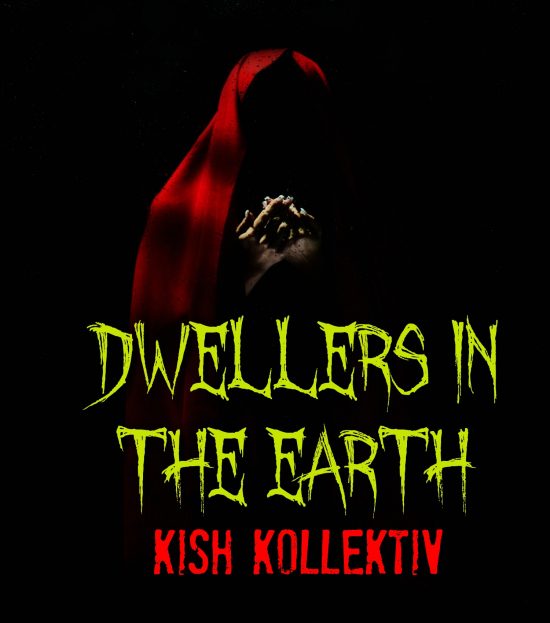
This was the “parallel universe” conceit: “Produced for UK television in 1982 by ATV, the undeservedly obscure “Dwellers in the Earth” is a loose adaptation of the late Karl Edward Wagner’s short story “Sticks” (itself an inspiration for “The Blair Witch Project”). The film – thought lost for many years until a somewhat degraded can of film reel turned up in a private collection in Hong Kong in 2009 – has been routinely described as one of the scariest made-for-television horror movies of all time. It was directed by the late Freddie Francis and starred Robert Powell and Jenny Agutter with Michael Ironside, Ian McCullough and Linda Hayden in supporting roles.
With the kind permission of the composer’s widow, Nadezhda Mastandrea, Kish Kollektiv has painstakingly recreated Staszek Korolenko’s long lost soundtrack score for the mysterious film. The UK-based Kollektiv gratefully acknowledges Mr. Korolenko’s huge influence on its own work. The Anglo-Belarusian composer died at the age of only 43, while the master recordings of many of his scores were later destroyed when the cellar of his family home flooded in 1989.”
You can listen to his latest release over on Spotify.
Now onto out chat…
- What drew you to the music industry?
The boring, obvious answer is a love of music and desire to make my own. We live in an era where recording equipment and software is much more affordable, it’s small enough to fit in your house and online shopping options make it far easier to source used instruments if your budget is tight. On top of that, putting your own music out has never been easier thanks to operations like CD Baby and Bandcamp and via the World Wide Web, you can potentially reach a global audience. I believe it was these favourable conditions which drew me to the industry in recent years, as well as a nagging urge to satisfy my musical muse which wouldn’t go away.
- Who are you inspired by?
Mostly by the main movers and shakers of the 1970s/80 “Golden Age” of synthesizer scores, John Carpenter, John Harrison, Goblin and Fabio Frizzi are the most obvious examples. I could also list electronica artists like Gary Numan, Vangelis and Jean-Michel Jarre as well as guitar gods like Steve Vai, Joe Satriani, Al Di Meola and Stanley Clarke. I also more subtly draw upon a ludicrously wide variety of genres for inspiration, stretching from hip-hop to industrial, power pop to baroque.
In terms of non-musical inspiration, I suppose it would be cinematic masters of horror like Romero, Carpenter, Fulci and Argento who created the films that necessitated the soundtrack scores. I must also give an honourable mention to the literary giants of the horror genre, King, Barker, Masterton and Laymon who must have played their part in fashioning my macabre leanings and in particular, the late Karl Edward Wagner, whose infamous 1970s short story “Sticks” was the clear and direct inspiration for my second release, “Dwellers in the Earth”.
- Please explain your creative process
When I was a teenager messing about with my electric guitar in my bedroom, I came up with a lot of musical ideas that never came close to being fully realised; you could call them embryonic music cues. Thankfully, I never truly forgot most of them and those that were forgotten were preserved on cassettes that I re-discovered a few years ago. Since I returned to composing, I began to mine those old ideas, developing them and merging them with newer ones. Some of them ended up very different from how my teenage self might have imagined…but some are scarily close to their original forms.
As I’m primarily a guitarist, a lot of my ideas start there, although they often become transformed into synthesizer elements as the piece in question takes form. At other times, I began with the drum and percussion tracks (before adding in synth and guitar parts), which can seriously influence the character of the composition or even the whole project, like the somewhat “dirty” sounding syncopated MCP500 drum tracks on “Children of the Cambion” or the looser, more free form percussion mostly from my old G-1000 featured on “Dwellers in the Earth”. In fact, on the latter, the only programmed drum tracks are metronomic kick drum sequences that crop up here and there.
One thing that always amazes me is how you can sometimes sit down to work without any particular solid idea in mind, start messing about aimlessly…and then you happen upon something, experience a “breakthrough” and it can lead very quickly to not only one complete idea but several. That is a great feeling, although it doesn’t always happen that way of course.
- Is there a hidden meaning in any of your music?
Not really, the intention is fairly “front and centre”. However, I’m of the belief that any art – whatever it may be – can be anything to anyone once it’s out there and sometimes people can divine all sorts of meanings that were never consciously intended.
- Do you collaborate with others? What is that process?
No, I’m a one man band at the moment, but I’ll never say never! That said, the voice actor Alyssa Penchanski played the part of paranormal investigator Ruscara Laudanski on the “Children of the Cambion” faux soundtrack, contributing an “in character” monologue to two of the tracks. We haven’t heard the last of Ruscara, so it’s likely I’ll be calling upon Ms. Penchanski again in future.
- Please discuss how you interact with and respond to fans
I still find it extraordinarily novel to consider myself – or rather Kish Kollektiv as a musical project strictly speaking – as having “fans”, although some people I’ve encountered in the last couple of years have made my day by describing themselves as such. I always try to be deferential, courteous and responsive in such situations…but I still feel somewhat like a “fraud” and probably always will haha.
I mostly interact with the online world as Kish Kollektiv through Twitter and while I’ve always held a negative view of social media, the individuals I’ve met through this medium are all thoroughly decent people and my experiences have been entirely positive…it’s how you choose to play the game I suppose.
- What is your favourite part about this line of work? Your least favourite? Why?
Although now I’m “officially” operating as an independent composer and I always seek to conduct myself as professionally as possible, I still struggle to think of my musical endeavours as “work” exactly. The rewards lie in satisfying my creative muse and my positive interactions with those who tell me they like what I come up with. My least favourite part of the whole thing is never being entirely happy with my own work to the point where sometimes I can’t listen to it I find so many faults. Thankfully I have my more lenient moments where I can temporarily forget it’s me and not only critique and assess the work but (almost!) enjoy it.
- What advice would you have for someone wanting to follow in your footsteps?
As it’s so much easier to set up as an independent musician these days without selling a kidney to raise the money, I’d say “go for it”. Make sure you have a steady income of some sort or at least money behind you and try to keep your overheads down wherever possible (I always try to acquire used or reconditioned equipment for example); it might be a very long before you recoup your investment…if at all. If you’re serious about making your passion into a full time career one day (or at least increasing the possibility) and if you can spare the money, you might want to enlist the services of a professional publicist. The downside of the accessibility of the music industry is that there are now so very many acts out there, all screaming to be heard as well; hiring an expert might give you an edge. The other thing I’d say is to be patient; some of the biggest bands and artists on the planet only reached that level through dogged persistence and determination, although I think we all get frustrated and dispirited sometimes. You could liken it to competition winners perhaps – they all have the same thing in common…they actually entered the competition. We have no right to feel cheated if we didn’t play the game.
Find him on all streaming and social media


Not the Usual LICK Publicist! 27 yrs in the biz ~Worldwide! Actual Peer of the Realm~Unitarian Universalist Pragmatic Buddhist~ PROUD GAY Liberal