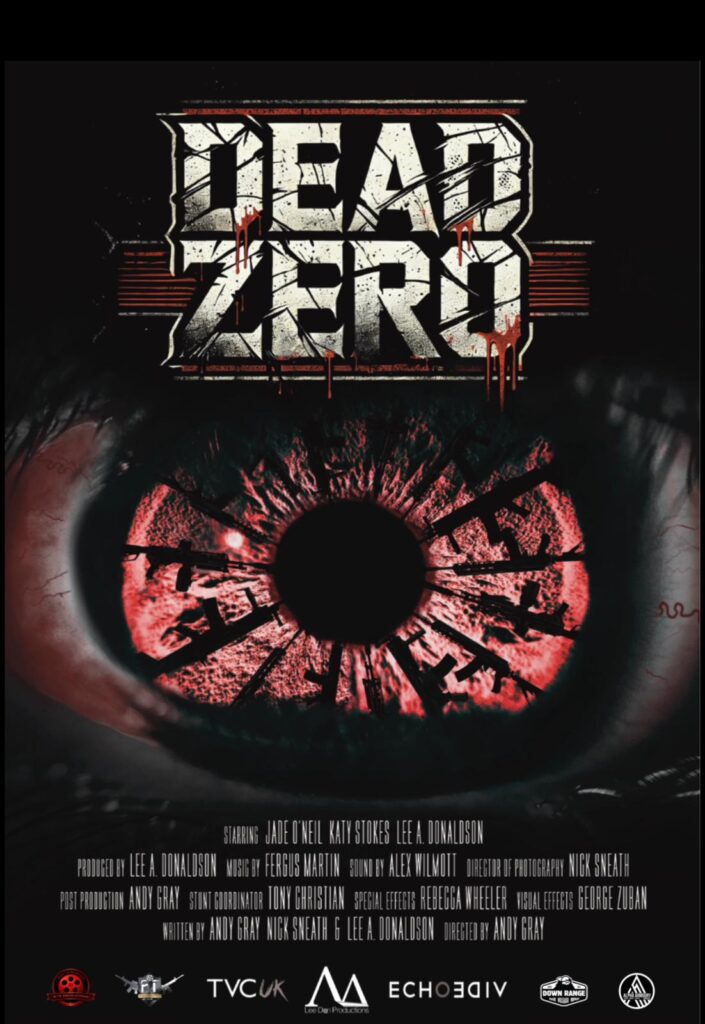
Film: Dead Zero
Director: Andy Gray
Writers: Lee Alan Donaldson, Andy Gray and Nick Sneath
Actors: Charlie Rich, Lee Alan Donaldson, Marton Virag, Sarah Louise Hughes, Ryan William
Zero Squad, an elite military team, infiltrate a research compound shrouded in mystery. As the squad uncovers the facility’s dark secrets, they face a deadly enemy that blurs the line between science and horror.
In a new Exclusive interview on Blazing Minds, I got a chance to ask Director/Co-Writer Andy Gray and Writer/Actor Lee Alan Donaldson a few questions about their horror short ‘Dead Zero’, which will have its world premiere at The Southend Film Festival as part of the Horror Takeover.
We are here to talk about Dead Zero today. Can you tell us a bit about the film?
Andy – The basic premise is that a crack team of mercenaries go on a mission to secure a facility in the depths of the English countryside. They don’t really know what they’re going to get, but when they arrive, they are attacked by enemy soldiers, and chaos ensues from there. It seems they are not just bad guys; there’s some illegal experimenting going on here, and potentially the odd zombie popping up to ruin their day.
How did the concept come about for Dead Zero?
Andy – It was a team of me, Lee and of co-writer Nick. We worked together on Jackal & Hide (2024), which was an action film. We wanted to do something a bit more developed and liked the idea of doing something in the horror genre. The funding model was based around having a big cast and getting lots of people involved. We wanted a story that could accommodate lots of characters and give them lots of things to do. We thought, we want to do a horror film so let’s go down the zombie route. That gives you a good opportunity to play with some visual effects, a lot of stunts and have some cool guns. So that’s where the premise came from.
Why did you decide to make it an action zombie film rather than a traditional sort of zombie movie?
Andy – It’s leaning into Lee’s background and the experience we had working on Jackal & Hide. Originally, Lee was very much inspired by things like the new Dawn of the Dead (2004). We all loved the grittiness of 28 Days Later (2002) and the military aspect of 28 Weeks Later (2007), so it’s combining all of those different elements.
I do like old horror zombies, British horror films, Hammer Horror, all that kind of stuff. So, I do like the slow-walking, looming dread of the old-fashioned zombies, but I think this gave us more scope and more freedom to make up our own rules.
Lee – The score has got that 80s action hero vibe, because like Andy said, we like the old stuff, but we wanted everything to be in the current time. We still have that theme, with different references and types of music that give 80s vibes.
Andy – We really wanted to push the predator team unit working together to destroy a threat, and as Lee said, we echoed that a bit with the score and those kinds of themes and ideas.
As you mentioned, there are three writers for the film itself. What’s the process of you working together to develop the script and the story?
Andy – It was really good fun. We met about a year ago now, and we were talking about an idea and fleshing out some vague concepts. Nick and I went away and jotted down our rough beats with the characters, what we wanted to see happen. We sent that to Lee, who had his input. I filled out most of the gaps, but then it would just kind of go back and forth. It’s a really nice way to work because you sit there and you think, “Oh, this is quite good, is this good?” Then you send it over, and they’re like, “Let’s try this, or “I don’t think this character’s doing enough, can we do this?” Because we had such a big cast, we were trying to give everyone something to do.
The short film has been selected to play at the Southend Film Festival. Can you tell a little bit about the film and how it compares to the feature?
Lee – I have listed this as chapter one, because essentially there are 3 chapters, it’s enough for the audience to understand what’s going on, but it won’t be disjointed and make no sense. Like Jackal & Hide, you will be thinking, how did they get to that situation, and what happens after the ending? So obviously that’s what’s missing.
In terms of how it’s dissimilar, the feature has flashbacks to explain how the science works and then the extended ending. Like Zombieland Double Tap (2019) – it’s those ideas of we’ve still got to kill this guy. The short part is the nice chunky part of the script, where you get to a lot of action and follow each different story arc individually from the different groups. Originally, it was only ever going to be a short, but as Andy, Nick, and I agreed, there’s too much scope to end it as just a short.
Andy – After the 3rd or 4th day of filming, Nick and I are driving home, and we spent the whole time going, okay, well, what happens afterwards? We were only halfway through the shoot, and we were already thinking, what happens next? As Lee said, it was conceived as a short film, but there are so many characters, and we had so many great performances, that as you’re filming it, you suddenly go, I want to see more of that person, want to see what happens to them afterwards.
Lee – It came with that ZombieLand: Double Tap reference; the main villain is not easy to kill. Obviously, we don’t want to overdo it, but naturally, we want to make it hard for the characters. The feedback we got from Jackal & Hide was that we were too dominant, and it was too easy for them. So, in this instance, we didn’t want the bad guy to be so easily defeated or the team that is fighting to just dominate him. There needs to be that real pushback. And obviously, it gives us more scope to develop different ideas for that final showdown, and a different way of killing him, which is not so predictable. But then again, do we kill him, do we not kill him? Who knows.
Changing from a short film to a feature concept, did that change the way the short was made in any way at all?

Lee – The short was already filmed and wrapped before we’d discussed writing the feature, so the short wasn’t influenced by the feature development. We got the funding together for the short and then discussed after how we can incorporate the rest of the moving components to make it that feature, which we’re still doing now. As you know, it’s hard to get funding and investment, but we’re hoping there’s enough to bite into here for the audience and the right people to go help you get that last bit over the line. We’re pretty much good to go with the feature script
Referring back to Jackal & Hide, the feedback we had from complete strangers were “How did they get there?” and “I wanted more”. Obviously, that’s the questions we want to hear because it shows they were truly invested, they believed the story and the characters. With Dead Zero, we want to deliver that as well. We got excited because there was so much more depth to it, which also allows potential sequels.
Andy – I have just about come to the end of the post on the short film, and we’re working on the scripts for the feature. Now Lee is already thinking about syndication, sequels, and TV spin-offs and all the rest.
Lee – You’ve got to have the producer hat on as well. Even if it never gets to the feature, in a non-biased way, it’s an incredible piece of work. Every layer that’s been added to that film, from the editing by Andy, to the VFX, the sound, the composing, is exceptional. We believe people will really enjoy it and want to keep watching the film. It won’t be just one of those ones you watch once and forget about it. They will rewatch it and want to have more; it’s exciting.
Going back to the filming, what were some of your favourite moments while working on the film?
Andy – We had this wonderful VFX artist, Rebecca Wheeler, who designed the zombies and created some amazing prosthetics that were used. We have all these conversations over Zoom, and she sends me designs, but seeing those in real life and sticking a camera on them, that’s very exciting.
We had some amazing stunt work with Tony Christian, we were in this basement in Watford. He rigged all these ropes up and was throwing people around. It’s those slightly terrifying moments as a director, when you realise there were an awful lot of people here. From makeup artists to actors, the ad hoc PA and runner. They were all there to work together and try to make something. When you get a moment, you go there’s a lot of people here working really hard to try and make something, those were really nice moments.
Lee – That’s the first 3 days because we shot the film in reverse, so we started off with the ending. It was pretty epic because there were about 30 plus people in that warehouse. It was a significantly large team of crew and cast, stunts, and everyone else, like Andy said. It was a proud moment when you see it visually for the first time. The location we have is so unique because you can’t use it ever again. We got that warehouse part because they said they were selling that section. For me, when I was looking around and seeing everyone in makeup. It was quite surreal, because we were actually doing it. Unlike Jackal & Hide, we had minimal makeup and setup, this was significant. 4 makeup artists, all these other additional crew members, everything was professional and very organised. It was a very proud moment, it looked epic like that location.
Working in low-budget filmmaking and bringing something this big to life is always difficult. Did you experience any difficulties bringing your vision to the screen, being how big it is compared to sort of your previous film?
Andy – It’s sort of my stock answer, but I think it’s just the amount of time. Your idea gets bigger, the amount of money you’ve got to spend gets slightly bigger, but you never have enough time. We were squeezing so much into like 12-hour days. Running people ragged. You’re fighting the time, the light, because even the stuff in the basement had a bit of natural daylight. You think that if we had one more day, we could have done that. A few more hours we could have done that. Lee was so good at putting a crew together, calling favours in, but time was the big one that I would have asked for more of. In terms of everything else, people’s performances were there, and the attitude of everyone was there; that’s what made it work.
Lee – We shop for 5 days, but ideally 7 would have been perfect. That final day we did in June, there was a break for a couple of months because we couldn’t get the last location set. Tony Christian let us use his facility to shoot the last scene in, which is a massive gun battle between loads of soldiers and henchmen. We had to do so many different scenes, on top of the stunts as well. As Andy said, that was probably too much. We needed 2 units, as you would in a normal production, so we had to cram a lot in 12 hours. I think that was the most stressful day, but because everyone was so invested and ready to sacrifice to get it done, we did still capture some great work. Obviously, there’s still, like, Andy said, there are things we could have done with pickups and inserts.
Andy – It’s a never-ending struggle because you would go, we’ve got 7 days, so let’s film more stuff. It’s difficult; the scope just gets bigger and bigger.
It would be nice to have a chair that I would have. If we can include that in the budget for the next film, so I can have a sit-down at some point. Most days in my life, I can do something for a bit and then, when I’m tired, sit down. There’s something about the energy of a film set that you just plough on because you’re constantly fighting time. So having to sit down at some point would be nice,
Lee – Okay, we’ll get the director’s chair.
Did you experience any issues during filming now at all?
Lee – Not really. We had the delay mentioned before the final location.
Andy – There’s an opening sequence in the woods. It’s come out really nice, but all I remember from the day is mud. Everything is covered in mud. It wasn’t glamorous that day. We were in a field in Hemal Hampstead, with actors in their dry robes standing on a tarpaulin in the middle of a field. Luckily, it didn’t rain, but just squirting through this mud, and telling the actors, could you run through the woods; and they’re like, “Well, if I can get my foot out of this hole, then, yeah, I’ll give it a go”. That was quite challenging,
Lee – That was the only day that we didn’t have an inside location. We weren’t prepared budget-wise to have tents, vans and trailers set up for everyone. I remember my brother-in-law had a buggy and was transporting everyone, but he stupidly didn’t cover anything. You could imagine all the food, guns, and cases were covered in mud. Everyone was pretty miserable on that field, and I just remember getting thick sludge out of pot noodle pots; it was horrendous. It did turn out really well, and that is the opening teaser we’ve recently shared. It looks great, but that was my least favourite day.
If you were to do the feature, when would you be looking to film?
Lee – We spoke about it the other week, Andy, Nick and myself, ideally want to shoot the ending, which is another 30 minutes or so, in May. That’s the ideal scenario, so we’re trying to work towards that schedule. The flashbacks for Act One would be later in the year. It depends on funds and availability, as you can imagine, there are lots of people involved and are booked elsewhere doing other works, but May would be what we ideally said we’d like to try and do.
I know you don’t give too much away, but what would you say makes your film stand out within the horror genre?
Andy – As much as having a big cast creates difficulties in terms of trying to get everything filmed, I don’t think you see films of this budget with that many people. I think, you know, we have a decent hoard of zombies at the end, and we have a lot of interesting characters. I think we’ve got some great, strong female leads, great prosthetics and just a lot of zombie fun.
Lee – If we do get to the stage where we have that feature, there are many things that Lucius, the main villain, has done with the science and the tech that is unique and different to other writing. I don’t know if you’ve seen Bone Temple (2026), but Danny Boyle has written something new. Which is great, because another writer is doing something new from the science perspective of medical science. We’ve done the same thing, but we’ve done that with tech and science that people haven’t seen before. I think any horror fan will go, that’s good, these guys are coming with something fresh and a bit different. People will appreciate that because we are in a society where content is constantly reinvented, let’s do a sequel, a prequel. And it’s like, no, let’s do something new. We’ve got nothing to lose. They might not like it, but at least we’re a bit different and not copycats. We draw upon lots of IPs and references, some funny little Easter eggs in there as well, which my sound guys put in. But we are a unique story and film, so hopefully that’ll be enough for people to speak about Dead Zero
You touched on your leads there. Did you have any actors in mind when you were writing a script for Dead Zero?
Lee – I’ve done the casting, but like what I did with Jackal & Hide, I sent options to Andy and Nick, and as the casting directors decided, between us, who we thought was suitable for those roles. Just because someone sent me £1000, it didn’t mean they got that lead role. We need those people to have the ability and talent and look to suit those roles, and I think we chose very well with who we’ve got, particularly with the two female lead characters.
Andy – I think to have the creative process, it’s all very fluid. As we were casting, there was the opportunity to rewrite and tweak a character to the actor’s personality, and I think they responded to that. Everyone sent in tapes of themselves, and then we did a lot of Zoom calls, talking through different characters. There was a real rehearsal process, which we didn’t have on Jacqueline Hyde. That was more like just turn up and fingers crossed, but this works because I think it was an opportunity for the actors to have a real input on their characters and for us to discuss. It’s not necessarily their backstories, but just how they want to be seen on screen, because this is as much a showcase for the actors as well.
Lee – We did physical rehearsals with firearms, acting rehearsals, going through the scenes. We did more rehearsals than Jackal & Hide with the table reads and Zoom calls, which was a game-changer, as Andy said, it was seamless and very fluid. People knew who they were, how to interact, so there wasn’t any disjointed lack of chemistry, and they didn’t come across like they just met.
Andy – When we’re talking about time, that maximises our time on set. Everyone turns up there and knows their lines. There’s obviously some flexibility in performances, and I can give directors notes, but we’ve sort of done a lot of that legwork. It’s normally a case of just blocking it out and getting the scene done. Which must have saved so much time.
Do you have any other projects you’re working on at the moment?
Andy – Nick’s got his own feature film that he’s written, I’m DOP for that, and helping do a bit of writing. I have a few ideas bubbling away, sort of started the rough outline of a new script, but nothing solid at the moment.
Lee – I’m just focused on Dead Zero for now. That’s, that’s, my baby. I want to help grow with Andy and Nick to see that through. For me, I’ve got nothing else planned until I’ve kind of put this one aside its finished, and then I can move on from there.
If someone’s looking to get into filmmaking, what advice would you give them?
Andy – I think you’ve just got to start. For me, it’s just getting hold of a camera, getting hold of the equipment and just getting started. From my point of view, it was all about just getting those opportunities. I went to Uni, and I studied film. I don’t know if the course itself was particularly helpful, but it gave me access to a library of equipment and performers. I spent almost every weekend working with the performing arts students or the music students, just filming stuff for them. Some stuff I would dread to look at now, but it gave me an idea of this works, this doesn’t work. Finding opportunities becomes harder as you get older because you’ve got a mortgage to pay, you’ve got kids and all the other stuff. Whereas if you’re in your 20s, you’re a student, just grab any opportunity. I think it is very easy to be taken advantage of, but if it’s something you’re really passionate about, you need to put the time in, get that experience, and make those connections.
Lee -For me, it’s just about building strong teams that you know you can work with. I take pride in selecting the right people to work together, so that’s how I network as a person in every walk of life, not just in the arts. That’s allowed me to get into this situation. The whole reason why it started with us guys is because Nick and I worked together many years ago because he booked me for an advert on StarNow. When I approached Nick with an idea about a script, he said, my friend Andy, who I didn’t know then, might be interested, let me have a chat with him. The three of us connected, and we thought, okay, let’s do things together. That wouldn’t have happened if I didn’t have the confidence to ask him, and he wouldn’t have the confidence in me to try and do it. When Andy and I first met, we were strangers. It’s bringing teams together, having the confidence in yourself and others to do it. Nick, Andy, and I, we all confident each other’s abilities and we’ve made 2 very good films together so far, in a very short time.
Any final comments before we end the interview? A
Andy – Even if the extent of Dead Zero is the short film that comes out in June, I’m incredibly proud of it. Again, Lee’s brought together a great team of creatives who are interested in making films, and you want to experience it. I think the film’s come out really nicely and I can’t wait for anyone to see it.
Lee – I would like to echo that and just get people to, like, comment and subscribe
You can also pre-order Dead Zero Chapter 1 here:
Full Details of the Southend Film Festival and Horror-on-Sea Takeover coming soon

Published in various websites, Philip is a reviewer who is best known for his interviews and media coverage of independent projects including; films, books, theatre and live events. Always on the lookout for something different to cover!