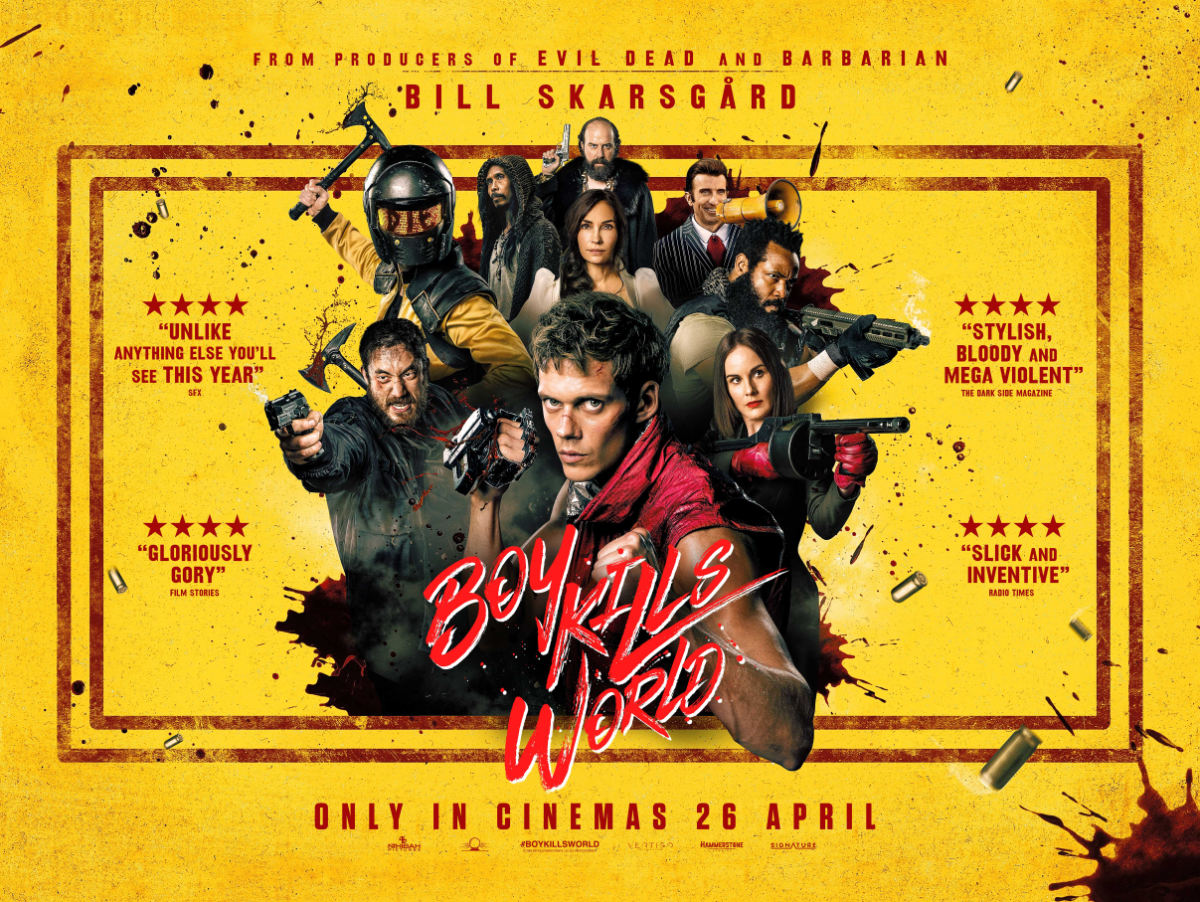


Those of you who are avid readers of the reviews here on Blazing Minds will have seen our review of Boy Kills World and how much I enjoyed the soundtrack by Ludvig Forrsell, I’m very pleased to be able to bring you an exclusive interview that I was able to do with Ludvig recently. Enjoy.
Can you tell our readers a little something about yourself?
I’m a composer working out of Tokyo, Japan. Originally from Sweden, I came to Japan in 2007 after finishing high school in what, I guess, at the time was an attempt to figure out what I wanted to do in life by slowing down and learning a new language for a while. That snowballed into going to college here studying music and then a career as a composer. I’d always been very much involved in music, but mostly as a musician playing in bands up until leaving Sweden and it was in figuring out that I preferred to create music from scratch -whilst living in Japan- that I realized being a composer was the way to go for me.
Since then I’ve worked as an in-house composer for Japanese video game companies writing the music for games such as Metal Gear Solid V: The Phantom Pain, Super Smash Brothers: Ultimate and DEATH STRANDING to name a few and lately going freelance I’ve been creating music for films such as Mamoru Hosoda’s BELLE and now Boy Kills World.
What genre of music would you say it falls under?
Tough question. While I’m most known for my work with Hideo Kojima creating music for games with a more of a dark synth/orchestra hybrid sound, I never really saw myself as that type of a composer. My background, playing in bands as a teenager, started with metal, death metal and then evolved into something weirder; sort of Frank Zappa-inspired. All that to say that I’m still searching for more opportunities to expand my musical voice beyond what got me started in the industry; I relish any chance to tap into the memories of the music I was surrounded by growing up.
Who are some of your musical influences?
Well, I mentioned Frank Zappa earlier and I can’t mention him without bringing up Mats Öberg and Morgan Ågren of MATS/MORGAN; their insane style of undefinable jazz/rock/experimental fusion had a huge impact on me during my younger days and I still aspire to somehow infuse those influences into my music.
As a guitarist, I was always blown away by Pat Metheny and spent all of high school trying to “figure out” jazz by playing his and also John Scofield’s songs (amongst others).
After becoming a composer though, my biggest inspiration and the sort of composer I one day wish to become is the late Jóhann Jóhannsson. I try to not compare myself with other composers, we all have our different approaches but every film I watched with his music in it has made me wish I could’ve done the same, haha. Just incredibly stunning and original every time.
What’s the story behind your work on Boy Kills World, how did you develop the style for the soundtrack?
Director Moritz Mohr had put together a playlist of music that he felt represented the style and world of Boy Kills World that I got sent to me even before getting onto the project. Now, this playlist featured music by artists such as Leon Michels -who also ended up writing songs for the film- and a smorgasbord of wild music from all around the world. Safe to say that it seemed like something completely out of my element… but as a composer that only intrigued me more as it would be a great chance and challenge for me to expand my repertoire.
As we started working on the score, I wanted to make sure that I adhered to these initial ideas that Moritz had, along with creating something that would work well together with what Leon was writing but also to add to that original vision; if I’m just aping back what was presented as initial ideas then I’m not really bringing anything new to the table. So, to come up with something new, I took to heart two basic core concepts: creating a sound/timbre that would portray the worldview of a main character who’s mute deaf and presenting an aural experience that has ethnic elements but never settles you in a specific country or culture.
The answer to this came through experimentation and random ideas leading me to purchase and learning a bunch of instruments such as Japanese gagaku flutes, african drums, didgeridoos etc. etc. and then resampling these to take them out of their original range and timbre while melding them all together into something I felt was new and interesting. With this I also incorporated voices, as the voice is the closest instrument to a human, to represent how Boy, the main character, perceives the world in his own mind. I must’ve spent hundreds of hours just whispering and humming into the mic to create the sort of clustery voice soundscape that I wanted for the film.
These elements and timbres were ultimately all tied down by a simple motif, the main theme of the film to solidify an overall “sound” or “style” for the soundtrack.
What has been your most memorable moment when composing the Boy Kills World soundtrack?
There is a track on the soundtrack called “We Are The Revolution” which features a children’s choir. It’s sort of a folk music style rock song with the choir’s vocals at its center and I wanted it to have a very lyrical feeling to it so I wrote lyrics for it. However, I did not want the lyrics to be easily discernible as to not take focus off the music as a whole so I wrote them in Swedish. Now, we were going to record the children’s choir in Budapest, Hungary and I’d written out the lyrics in phonetic English but given the trickiness of the track along with the weird language lyrics I was very concerned whether or not we could pull it off. On the day of the children’s choir recording I walk into the recording studio and the choir is there rehearsing this track in near perfect Swedish, totally nailing it. At that moment I felt sure we were going to pull this whole soundtrack off. It was AWESOME.
Where do you draw inspiration for your music?
I tend to let my daily life lead me to my inspiration. By that I mean, when I feel like I need a break or to lessen my output for a while, I’ll switch off completely and go for an early nice dinner or even go away on a short trip for a few days. The actual inspiration then usually follows as I focus on what to write next by looking at the material and building an idea in my head.
Generally speaking; I don’t go out of my way to seek out “new” things, what led me to where I am today has always been just following my heart and never doubting that (at least trying to). I rarely listen to music these days but I’m always surrounded by music in one way or another and I think that that, and everything else in “being alive” is what really propels me forward.
How does composing for a video game differ from that of a motion picture?
Any given media will have its quirks or stand out differences; notably what stage composition takes place being very different between film, games and tv or anime. Films tend to have the composer working to a locked somewhat finalized picture whereas in-game music for video games is written against a “presumed” vision of any certain gameplay situation and anime music, for example, is often written to storyboard.
What mostly sets video game music and motion picture music apart though is the fact that video games are interactive and the music needs to be able to respond on the fly to player input in order to then create as much of a “tailored experience” as possible. This of course impacts the approach for composition in a way where you might be adding to what could be considered a complete piece of music just to account for additional situations where music needs to strip away certain layers but retain its functionality as music. This is of course not the case for motion pictures but I do think that my experience with video games and their music’s special needs has a big influence in anything I write; I always try to go the extra mile to make sure everything is covered.
How do you go about writing your compositions?
I think the most important part of writing and finishing a piece of music is always the core idea; the start.
Now, it depends on the sort of music I’m writing; a lot might just start by something clicking between seeing a scene and understanding its tempo to then have a core idea form in my head that I then try to put down as fast as possible to build off of.
Another big inspiration for me when starting a piece is timbre. Be it playing around on a synth and creating a new sound or finding the correct drum sample, the smallest nugget could be what inspires me to see beyond that initial diamond in the rough and helps me expand it into a fully fledged cue.
Again, it depends on what I’m working on but after finding that first stepping stone I usually write out the entire track very roughly so that I know what the major structure will be before getting into detail and writing out all parts of the arrangement and tweaking things back and forth. Once it’s all done it’s not unusual for me to find that the core idea has evolved or is now part of several core ideas or has even been replaced; the most important thing is that the track has a “soul” in that you can tell that there is an idea in there that makes it stand on its own as an original piece of music.
What do you have lined up next?
I’m in the middle of writing the music to the sequel of the last game I did with Kojima Productions; DEATH STRANDING 2. It’s a great experience to be able to keep working with the people who helped create the first one and I really look forward to having people see what new stuff we are doing for the music in this follow-up.
Other than that I am also writing the music for a full season of a new anime series, which is a first for me. Can’t say much about it other than it’s affording me the chance to once again try out things that people might not expect from me which is so much fun!
A massive thank you to Ludvig Forssell for allowing us to chat with him about his music and more, check out the score for Boy Kills World on Amazon.

Karen Woodham is the founder and owner of the Blazing Minds. She is also a Cinema reviewer and works with RealD 3D reviewing the latest 3D releases and IMAX, she has also had several articles published in various publications including the first edition of SFW Magazine. In 2015 she became an Award Winning Blogger and also has her website listed as one of the UK’s Top 10 Film Blogs.